Advertisements
Advertisements
प्रश्न
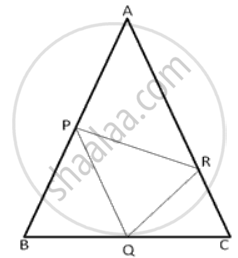
In ABC, P, Q and R are points on AB, BC and AC respectively. Prove that AB + BC + AC > PQ + QR + PR.
Advertisements
उत्तर
In triangle APR,
AP + AR > PR ......(i)
In triangle BPQ,
BQ + PB > PQ .......(ii)
In triangle QCR,
QC + CR > QR .......(iii)
Adding (i), (ii) and (iii)
AP + AR + BQ + PB + QC + CR > PR + PQ + QR
(AP + PB) + (BQ + QC) + (CR + AR) > PR + QR + PQ)
⇒ AB + BC + AC > PQ + QR + PR.
APPEARS IN
संबंधित प्रश्न
Show that in a right angled triangle, the hypotenuse is the longest side.
ABC is a triangle. Locate a point in the interior of ΔABC which is equidistant from all the vertices of ΔABC.
From the following figure, prove that: AB > CD.

In the following figure, write BC, AC, and CD in ascending order of their lengths.
In the following figure ; AC = CD; ∠BAD = 110o and ∠ACB = 74o.
Prove that: BC > CD.
"Issues of caste discrimination began to be written about in many printed tracts and essays in India in the late nineteenth century." Support the statement with two suitable examples.
Name the greatest and the smallest sides in the following triangles:
ΔXYZ, ∠X = 76°, ∠Y = 84°.
Arrange the sides of the following triangles in an ascending order:
ΔABC, ∠A = 45°, ∠B = 65°.
ΔABC is isosceles with AB = AC. If BC is extended to D, then prove that AD > AB.
In the given figure, ∠QPR = 50° and ∠PQR = 60°. Show that: SN < SR
