Advertisements
Advertisements
प्रश्न
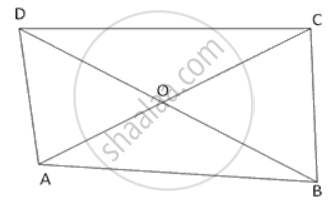
ABCD is a quadrilateral in which the diagonals AC and BD intersect at O. Prove that AB + BC + CD + AD < 2(AC + BC).
Advertisements
उत्तर
In ΔAOB, we have
OA + OB > AB ...(i)
In ΔBOC, we have
OB + OC > BC ...(ii)
In ΔCOD, we have
OC + OD > CD ...(iii)
In ΔAOD, we have
OA + OD > AD ....(iv)
Adding (i), (ii), (iii) and (iv), we get
2 (OA + OB + OC + OD) > AB + BC + CD + AD
⇒ 2 [(OA + OC) + (OB + OD)] > AB + BC + CD + AD
⇒ 2 (AC + BD) > AB + BC + CD + AD
[∵ OA + OC = AC and OB + OD = BD]
⇒ AB + BC + CD + AD < 2 (AC + BD).
APPEARS IN
संबंधित प्रश्न
AB and CD are respectively the smallest and longest sides of a quadrilateral ABCD (see the given figure). Show that ∠A > ∠C and ∠B > ∠D.

ABC is a triangle. Locate a point in the interior of ΔABC which is equidistant from all the vertices of ΔABC.
In a huge park people are concentrated at three points (see the given figure):

A: where there are different slides and swings for children,
B: near which a man-made lake is situated,
C: which is near to a large parking and exit.
Where should an ice-cream parlour be set up so that maximum number of persons can approach it?
(Hint: The parlor should be equidistant from A, B and C)
Complete the hexagonal and star shaped rangolies (see the given figures) by filling them with as many equilateral triangles of side 1 cm as you can. Count the number of triangles in each case. Which has more triangles?

"Issues of caste discrimination began to be written about in many printed tracts and essays in India in the late nineteenth century." Support the statement with two suitable examples.
Name the smallest angle in each of these triangles:
In ΔXYZ, XY = 6.2cm, XY = 6.8cm and YZ = 5cm
ABCD is a trapezium. Prove that:
CD + DA + AB + BC > 2AC.
ABCD is a trapezium. Prove that:
CD + DA + AB > BC.
In ΔPQR, PS ⊥ QR ; prove that: PQ > QS and PQ > PS
In the given figure, T is a point on the side PR of an equilateral triangle PQR. Show that RT < QT
