Advertisements
Advertisements
Question
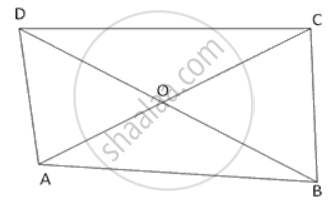
ABCD is a quadrilateral in which the diagonals AC and BD intersect at O. Prove that AB + BC + CD + AD < 2(AC + BC).
Advertisements
Solution
In ΔAOB, we have
OA + OB > AB ...(i)
In ΔBOC, we have
OB + OC > BC ...(ii)
In ΔCOD, we have
OC + OD > CD ...(iii)
In ΔAOD, we have
OA + OD > AD ....(iv)
Adding (i), (ii), (iii) and (iv), we get
2 (OA + OB + OC + OD) > AB + BC + CD + AD
⇒ 2 [(OA + OC) + (OB + OD)] > AB + BC + CD + AD
⇒ 2 (AC + BD) > AB + BC + CD + AD
[∵ OA + OC = AC and OB + OD = BD]
⇒ AB + BC + CD + AD < 2 (AC + BD).
APPEARS IN
RELATED QUESTIONS
Show that in a right angled triangle, the hypotenuse is the longest side.
In the given figure sides AB and AC of ΔABC are extended to points P and Q respectively. Also, ∠PBC < ∠QCB. Show that AC > AB.

In the given figure, PR > PQ and PS bisects ∠QPR. Prove that ∠PSR >∠PSQ.

In a triangle locate a point in its interior which is equidistant from all the sides of the triangle.
In a huge park people are concentrated at three points (see the given figure):

A: where there are different slides and swings for children,
B: near which a man-made lake is situated,
C: which is near to a large parking and exit.
Where should an ice-cream parlour be set up so that maximum number of persons can approach it?
(Hint: The parlor should be equidistant from A, B and C)
Arrange the sides of ∆BOC in descending order of their lengths. BO and CO are bisectors of angles ABC and ACB respectively.

Name the greatest and the smallest sides in the following triangles:
ΔDEF, ∠D = 32°, ∠E = 56° and ∠F = 92°.
In a triangle ABC, BC = AC and ∠ A = 35°. Which is the smallest side of the triangle?
ABCD is a trapezium. Prove that:
CD + DA + AB > BC.
In the given figure, ∠QPR = 50° and ∠PQR = 60°. Show that: SN < SR
