Advertisements
Advertisements
Question
In ΔABC, BC produced to D, such that, AC = CD; ∠BAD = 125° and ∠ACD = 105°. Show that BC > CD.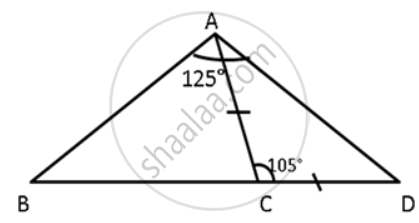
Sum
Advertisements
Solution
In ΔACD,
AC = CD ....(Given)
∠CDA = ∠DAC ....(ΔACD is isosceles triangle.)
Let ∠CDA = ∠DAC = x°
∠CDA + ∠DAC + ∠ACD = 180°
x° + x° + 105° = 180°
2x° + 180° - 105°
2x° = 75°
x = `(75°)/(2)`
x = 37.5°
∠C = ∠DAC = x° = 37.5° ......(i)
∠DAC =∠AC + ∠BAC
125° - 37.5° = ∠BAC ....from (i)
125° - 37.5° = ∠BAC
87.5° = ∠BAC
Also, ∠BCA + ∠ACD = 180°
⇒ ∠BCA + 105° = 180°
⇒ ∠BCA = 75°
So, in ΔBAC,
∠ACB + ∠BAC + ∠C = 180°
⇒ 75° + 87.5° + ∠ABC = 180°
⇒ ∠ABC = 17.5°
As 87.5° > 17.5°
∠BAC > ∠ABC
⇒ BC > AC
⇒ BC > CD. ....(Since AC = CD)
shaalaa.com
Is there an error in this question or solution?
