Advertisements
Advertisements
प्रश्न
Show that of all line segments drawn from a given point not on it, the perpendicular line segment is the shortest.
Advertisements
उत्तर
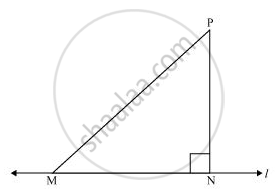
Let us take a line l and from point P (i.e., not on line l), draw two line segments PN and PM. Let PN be perpendicular to line l and PM is drawn at some other angle.
In ΔPNM,
∠N = 90º
∠P + ∠N + ∠M = 180º (Angle sum property of a triangle)
∠P + ∠M = 90º
Clearly, ∠M is an acute angle.
∴ ∠M < ∠N
⇒ PN < PM (Side opposite to the smaller angle is smaller)
Similarly, by drawing different line segments from P to l, it can be proved that PN is smaller in comparison to them.
Therefore, it can be observed that of all line segments drawn from a given point not on it, the perpendicular line segment is the shortest.
संबंधित प्रश्न
Show that in a right angled triangle, the hypotenuse is the longest side.
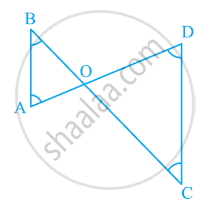
In the given figure, ∠B < ∠A and ∠C < ∠D. Show that AD < BC.
In a triangle PQR; QR = PR and ∠P = 36o. Which is the largest side of the triangle?
D is a point in side BC of triangle ABC. If AD > AC, show that AB > AC.
In the following figure ; AC = CD; ∠BAD = 110o and ∠ACB = 74o.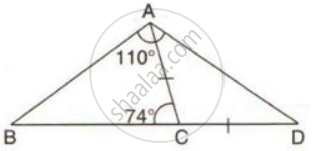
Prove that: BC > CD.
In the following figure, write BC, AC, and CD in ascending order of their lengths.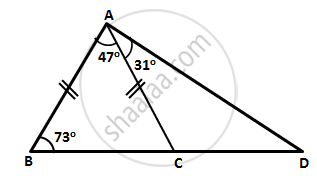
“Caste inequalities are still prevalent in India.” Examine the statement.
In a triangle ABC, BC = AC and ∠ A = 35°. Which is the smallest side of the triangle?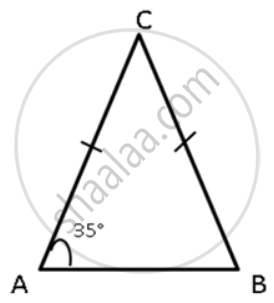
ABCD is a trapezium. Prove that: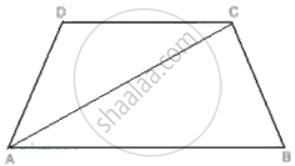
CD + DA + AB + BC > 2AC.
ABCD is a trapezium. Prove that: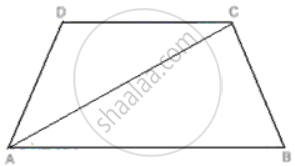
CD + DA + AB > BC.
