Advertisements
Advertisements
Question
if `x^m y^n = (x + y)^(m + n)`, prove that `(d^2y)/(dx^2)= 0`
Advertisements
Solution
We are given
`x^m y^n = (x + y)^(m + n)`
Taking log on both sides, we get

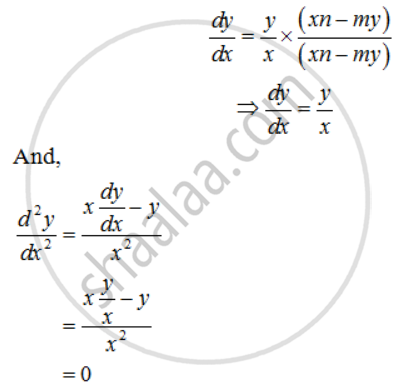
APPEARS IN
RELATED QUESTIONS
Differentiate the function with respect to x.
cos x . cos 2x . cos 3x
Differentiate the function with respect to x.
`(sin x)^x + sin^(-1) sqrtx`
Differentiate the function with respect to x.
xsin x + (sin x)cos x
Find `bb(dy/dx)` for the given function:
yx = xy
Find `bb(dy/dx)` for the given function:
(cos x)y = (cos y)x
Find `bb(dy/dx)` for the given function:
xy = `e^((x - y))`
If `y = sin^-1 x + cos^-1 x , "find" dy/dx`
Find `(dy)/(dx) , if y = sin ^(-1) [2^(x +1 )/(1+4^x)]`
Differentiate : log (1 + x2) w.r.t. cot-1 x.
If `log_10((x^3 - y^3)/(x^3 + y^3))` = 2, show that `dy/dx = -(99x^2)/(101y^2)`.
If xy = ex–y, then show that `"dy"/"dx" = logx/(1 + logx)^2`.
If x = `asqrt(secθ - tanθ), y = asqrt(secθ + tanθ), "then show that" "dy"/"dx" = -y/x`.
If x = a cos3t, y = a sin3t, show that `"dy"/"dx" = -(y/x)^(1/3)`.
If x = `(2bt)/(1 + t^2), y = a((1 - t^2)/(1 + t^2)), "show that" "dx"/"dy" = -(b^2y)/(a^2x)`.
Find the nth derivative of the following: log (ax + b)
Find the nth derivative of the following : log (2x + 3)
If f(x) = logx (log x) then f'(e) is ______
`log [log(logx^5)]`
If xm . yn = (x + y)m+n, prove that `"dy"/"dx" = y/x`
If y = `log ((1 - x^2)/(1 + x^2))`, then `"dy"/"dx"` is equal to ______.
`lim_("x" -> 0)(1 - "cos x")/"x"^2` is equal to ____________.
If `"y" = "e"^(1/2log (1 + "tan"^2"x")), "then" "dy"/"dx"` is equal to ____________.
Derivative of log (sec θ + tan θ) with respect to sec θ at θ = `π/4` is ______.
The derivative of x2x w.r.t. x is ______.
If y = `log(x + sqrt(x^2 + 4))`, show that `dy/dx = 1/sqrt(x^2 + 4)`
If \[y=x^x+x^{\frac{1}{x}}\] then \[\frac{\mathrm{d}y}{\mathrm{d}x}\] is equal to
For which type of function is logarithmic differentiation especially useful?
What condition must be ensured for an expression inside logarithm?
