Advertisements
Advertisements
प्रश्न
if `x^m y^n = (x + y)^(m + n)`, prove that `(d^2y)/(dx^2)= 0`
Advertisements
उत्तर
We are given
`x^m y^n = (x + y)^(m + n)`
Taking log on both sides, we get

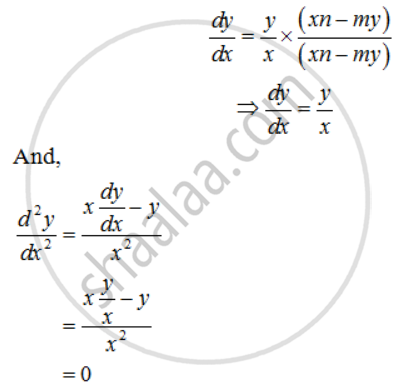
APPEARS IN
संबंधित प्रश्न
Differentiate the following function with respect to x: `(log x)^x+x^(logx)`
if xx+xy+yx=ab, then find `dy/dx`.
Differentiate the function with respect to x.
cos x . cos 2x . cos 3x
Differentiate the function with respect to x.
`(x + 1/x)^x + x^((1+1/x))`
Find the derivative of the function given by f(x) = (1 + x) (1 + x2) (1 + x4) (1 + x8) and hence find f′(1).
Find `dy/dx` if y = xx + 5x
Find `"dy"/"dx"` , if `"y" = "x"^("e"^"x")`
Find `"dy"/"dx"` if y = xx + 5x
If y = (log x)x + xlog x, find `"dy"/"dx".`
If log (x + y) = log(xy) + p, where p is a constant, then prove that `"dy"/"dx" = (-y^2)/(x^2)`.
If x = a cos3t, y = a sin3t, show that `"dy"/"dx" = -(y/x)^(1/3)`.
If x = log(1 + t2), y = t – tan–1t,show that `"dy"/"dx" = sqrt(e^x - 1)/(2)`.
If x = `(2bt)/(1 + t^2), y = a((1 - t^2)/(1 + t^2)), "show that" "dx"/"dy" = -(b^2y)/(a^2x)`.
If y = `log(x + sqrt(x^2 + a^2))^m`, show that `(x^2 + a^2)(d^2y)/(dx^2) + x "d"/"dx"` = 0.
If x7 . y5 = (x + y)12, show that `("d"y)/("d"x) = y/x`
The rate at which the metal cools in moving air is proportional to the difference of temperatures between the metal and air. If the air temperature is 290 K and the metal temperature drops from 370 K to 330 K in 1 O min, then the time required to drop the temperature upto 295 K.
Derivative of loge2 (logx) with respect to x is _______.
`d/dx(x^{sinx})` = ______
If `("f"(x))/(log (sec x)) "dx"` = log(log sec x) + c, then f(x) = ______.
`lim_("x" -> -2) sqrt ("x"^2 + 5 - 3)/("x" + 2)` is equal to ____________.
If `"f" ("x") = sqrt (1 + "cos"^2 ("x"^2)), "then the value of f'" (sqrtpi/2)` is ____________.
If `"y" = "e"^(1/2log (1 + "tan"^2"x")), "then" "dy"/"dx"` is equal to ____________.
If `f(x) = log [e^x ((3 - x)/(3 + x))^(1/3)]`, then `f^'(1)` is equal to
If y = `log(x + sqrt(x^2 + 4))`, show that `dy/dx = 1/sqrt(x^2 + 4)`
The derivative of log x with respect to `1/x` is ______.
What is the first step in the standard procedure for \[y=[u(x)]^{v(x)}\]?
Which derivative correctly represents differentiating \[\ln y\] carefully?
What condition must be ensured for an expression inside logarithm?
