Advertisements
Advertisements
प्रश्न
if `x^m y^n = (x + y)^(m + n)`, prove that `(d^2y)/(dx^2)= 0`
Advertisements
उत्तर
We are given
`x^m y^n = (x + y)^(m + n)`
Taking log on both sides, we get

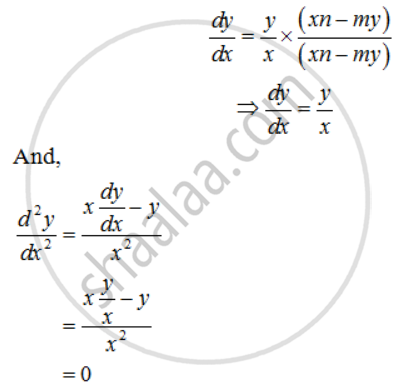
APPEARS IN
संबंधित प्रश्न
Differentiate the function with respect to x.
`(sin x)^x + sin^(-1) sqrtx`
Differentiate the function with respect to x.
`(x cos x)^x + (x sin x)^(1/x)`
If y = `e^(acos^(-1)x)`, −1 ≤ x ≤ 1, show that `(1- x^2) (d^2y)/(dx^2) -x dy/dx - a^2y = 0`.
Find `(dy)/(dx) , if y = sin ^(-1) [2^(x +1 )/(1+4^x)]`
Evaluate
`int 1/(16 - 9x^2) dx`
Differentiate
log (1 + x2) w.r.t. tan-1 (x)
Differentiate : log (1 + x2) w.r.t. cot-1 x.
If `"x"^(5/3) . "y"^(2/3) = ("x + y")^(7/3)` , the show that `"dy"/"dx" = "y"/"x"`
If x = `asqrt(secθ - tanθ), y = asqrt(secθ + tanθ), "then show that" "dy"/"dx" = -y/x`.
If x = a cos3t, y = a sin3t, show that `"dy"/"dx" = -(y/x)^(1/3)`.
If x = log(1 + t2), y = t – tan–1t,show that `"dy"/"dx" = sqrt(e^x - 1)/(2)`.
Differentiate 3x w.r.t. logx3.
If y = A cos (log x) + B sin (log x), show that x2y2 + xy1 + y = 0.
If y = 5x. x5. xx. 55 , find `("d"y)/("d"x)`
If xy = ex-y, then `"dy"/"dx"` at x = 1 is ______.
`log [log(logx^5)]`
If xm . yn = (x + y)m+n, prove that `"dy"/"dx" = y/x`
If y = `(1 + 1/x)^x` then `(2sqrt(y_2(2) + 1/8))/((log 3/2 - 1/3))` is equal to ______.
If `log_10 ((x^3 - y^3)/(x^3 + y^3))` = 2 then `dy/dx` = ______.
Derivative of log (sec θ + tan θ) with respect to sec θ at θ = `π/4` is ______.
If y = `9^(log_3x)`, find `dy/dx`.
Find `dy/dx`, if y = (log x)x.
After differentiating \[\log y=v(x)\cdot\log[u(x)]\], which equation is obtained?
Which is the derivative of \[\sqrt{\frac{(x-3)(x^2+4)}{3x^2+4x+5}}\]?
For \[y=x^{\sin x}\], \[x>0\], what equation results after taking logarithm on both sides?
