Advertisements
Advertisements
प्रश्न
if xx+xy+yx=ab, then find `dy/dx`.
Advertisements
उत्तर १
xx+xy+yx=ab........(i)
`Let u=x^x`
`log u=xlogx`
`1/u*(du)/dx=x * 1/x+logx`
`therefore (du)/dx=x^x(1+logx)`
`Let v=x^y`
`logv =ylogx`
`1/v (dv)/dx=(y/x+logx dy/dx)`
`therefore (dv)/dx=x^y(y/x+logx dy/dx)`
`Let w=y^x`
`logw=x log y`
`1/w.(dw)/dx=(x/y*dy/dx+logy)`
`therefore (dw)/dx=y^x(logy+x/y*dy/dx)`
(i) can be written as
u + v + w = ab
`du/dx+dv/dx+dw/dx=0`
`=>x^x+x^xlogx+x^yy/x+x^y logx dy/dx+y^xlogy+y^x x/y dy/dx=0`
`=>dy/dx(x^ylogx+y^x x/y)=x^x+x^xlogx+x^y y/x+ y^x logy`
`=> dy/dx (x^y*logx+xy^(x-1))=(x^x+x^xlogx+yx^(y-1)+y^x*logy)`
`therefore dy/dx=(x^x+x^xlogx+yx^(y-1)+y^x*logy)/(x^y*logx+xy^(x-1))`
उत्तर २
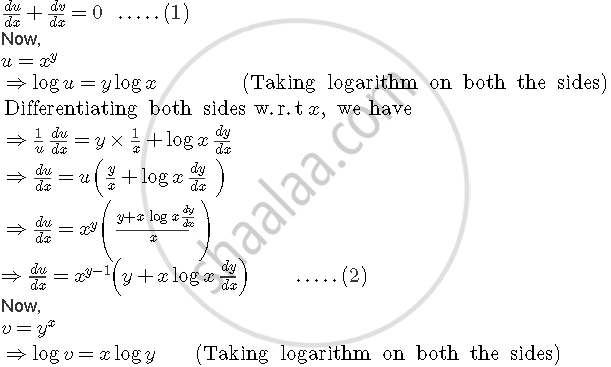
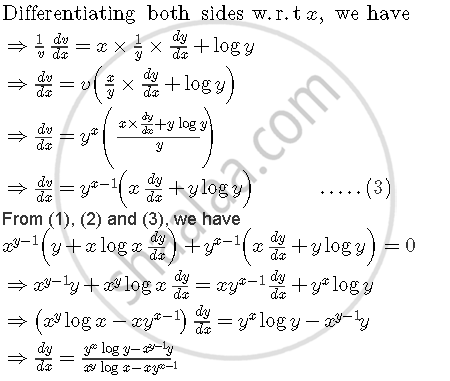
Let u = xy and v = yx
Then, u + v = ab
Differentiating both sides w.r.t x, we get
संबंधित प्रश्न
Differentiate the function with respect to x.
`sqrt(((x-1)(x-2))/((x-3)(x-4)(x-5)))`
Differentiate the function with respect to x.
(log x)cos x
Differentiate the function with respect to x.
xsin x + (sin x)cos x
Differentiate (x2 – 5x + 8) (x3 + 7x + 9) in three ways mentioned below:
- By using the product rule.
- By expanding the product to obtain a single polynomial.
- By logarithmic differentiation.
Do they all give the same answer?
If u, v and w are functions of x, then show that `d/dx(u.v.w) = (du)/dx v.w + u. (dv)/dx.w + u.v. (dw)/dx` in two ways-first by repeated application of product rule, second by logarithmic differentiation.
If y = `e^(acos^(-1)x)`, −1 ≤ x ≤ 1, show that `(1- x^2) (d^2y)/(dx^2) -x dy/dx - a^2y = 0`.
If ey ( x +1) = 1, then show that `(d^2 y)/(dx^2) = ((dy)/(dx))^2 .`
Differentiate
log (1 + x2) w.r.t. tan-1 (x)
Find `"dy"/"dx"` if y = xx + 5x
Solve the following differential equation: (3xy + y2) dx + (x2 + xy) dy = 0
If xy = ex–y, then show that `"dy"/"dx" = logx/(1 + logx)^2`.
If x = `asqrt(secθ - tanθ), y = asqrt(secθ + tanθ), "then show that" "dy"/"dx" = -y/x`.
If x = `(2bt)/(1 + t^2), y = a((1 - t^2)/(1 + t^2)), "show that" "dx"/"dy" = -(b^2y)/(a^2x)`.
Find the second order derivatives of the following : x3.logx
If y = `log[sqrt((1 - cos((3x)/2))/(1 +cos((3x)/2)))]`, find `("d"y)/("d"x)`
Derivative of loge2 (logx) with respect to x is _______.
If y = `{f(x)}^{phi(x)}`, then `dy/dx` is ______
`"d"/"dx" [(cos x)^(log x)]` = ______.
If y = `("e"^"2x" sin x)/(x cos x), "then" "dy"/"dx" = ?`
If y = `log ((1 - x^2)/(1 + x^2))`, then `"dy"/"dx"` is equal to ______.
If `f(x) = log [e^x ((3 - x)/(3 + x))^(1/3)]`, then `f^'(1)` is equal to
Find `dy/dx`, if y = (sin x)tan x – xlog x.
The derivative of log x with respect to `1/x` is ______.
Find `dy/dx`, if y = (log x)x.
For which type of function is logarithmic differentiation especially useful?
If \[y=[u(x)]^{v(x)}\], which expression gives \[\frac{dy}{dx}\] in logarithmic differentiation?
Which is the derivative of \[\sqrt{\frac{(x-3)(x^2+4)}{3x^2+4x+5}}\]?
