Advertisements
Advertisements
Question
if xx+xy+yx=ab, then find `dy/dx`.
Advertisements
Solution 1
xx+xy+yx=ab........(i)
`Let u=x^x`
`log u=xlogx`
`1/u*(du)/dx=x * 1/x+logx`
`therefore (du)/dx=x^x(1+logx)`
`Let v=x^y`
`logv =ylogx`
`1/v (dv)/dx=(y/x+logx dy/dx)`
`therefore (dv)/dx=x^y(y/x+logx dy/dx)`
`Let w=y^x`
`logw=x log y`
`1/w.(dw)/dx=(x/y*dy/dx+logy)`
`therefore (dw)/dx=y^x(logy+x/y*dy/dx)`
(i) can be written as
u + v + w = ab
`du/dx+dv/dx+dw/dx=0`
`=>x^x+x^xlogx+x^yy/x+x^y logx dy/dx+y^xlogy+y^x x/y dy/dx=0`
`=>dy/dx(x^ylogx+y^x x/y)=x^x+x^xlogx+x^y y/x+ y^x logy`
`=> dy/dx (x^y*logx+xy^(x-1))=(x^x+x^xlogx+yx^(y-1)+y^x*logy)`
`therefore dy/dx=(x^x+x^xlogx+yx^(y-1)+y^x*logy)/(x^y*logx+xy^(x-1))`
Solution 2
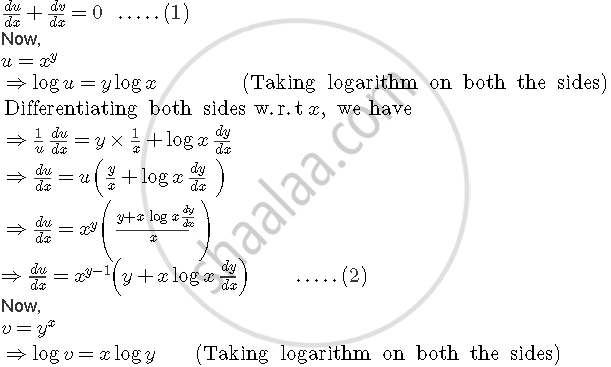
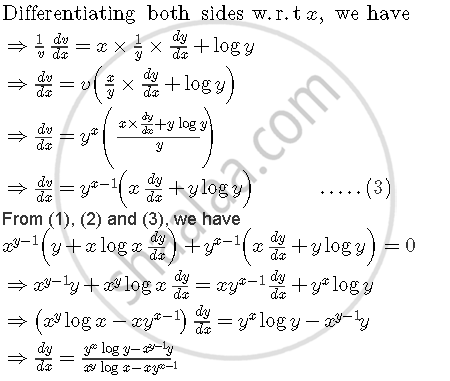
Let u = xy and v = yx
Then, u + v = ab
Differentiating both sides w.r.t x, we get
RELATED QUESTIONS
If `y=log[x+sqrt(x^2+a^2)]` show that `(x^2+a^2)(d^2y)/(dx^2)+xdy/dx=0`
Differentiate the function with respect to x.
cos x . cos 2x . cos 3x
Differentiate the function with respect to x.
(log x)x + xlog x
Differentiate the function with respect to x.
`(sin x)^x + sin^(-1) sqrtx`
Find `bb(dy/dx)` for the given function:
(cos x)y = (cos y)x
Find the derivative of the function given by f(x) = (1 + x) (1 + x2) (1 + x4) (1 + x8) and hence find f′(1).
Find `(dy)/(dx) , if y = sin ^(-1) [2^(x +1 )/(1+4^x)]`
Evaluate
`int 1/(16 - 9x^2) dx`
Differentiate
log (1 + x2) w.r.t. tan-1 (x)
Find `"dy"/"dx"` , if `"y" = "x"^("e"^"x")`
Find `"dy"/"dx"` if y = xx + 5x
`"If" y = sqrt(logx + sqrt(log x + sqrt(log x + ... ∞))), "then show that" dy/dx = (1)/(x(2y - 1).`
If x = esin3t, y = ecos3t, then show that `dy/dx = -(ylogx)/(xlogy)`.
If x = 2cos4(t + 3), y = 3sin4(t + 3), show that `"dy"/"dx" = -sqrt((3y)/(2x)`.
Find the second order derivatives of the following : log(logx)
If y = `25^(log_5sin_x) + 16^(log_4cos_x)` then `("d"y)/("d"x)` = ______.
If x7 . y5 = (x + y)12, show that `("d"y)/("d"x) = y/x`
The rate at which the metal cools in moving air is proportional to the difference of temperatures between the metal and air. If the air temperature is 290 K and the metal temperature drops from 370 K to 330 K in 1 O min, then the time required to drop the temperature upto 295 K.
`2^(cos^(2_x)`
`8^x/x^8`
`log [log(logx^5)]`
If xm . yn = (x + y)m+n, prove that `"dy"/"dx" = y/x`
If y = `x^(x^2)`, then `dy/dx` is equal to ______.
If `log_10 ((x^2 - y^2)/(x^2 + y^2))` = 2, then `dy/dx` is equal to ______.
What is logarithmic differentiation?
For which type of function is logarithmic differentiation especially useful?
