Advertisements
Advertisements
Question
Give IUPAC name of the compound given below.
\[\begin{array}{cc}
\phantom{}\ce{CH3 - CH - CH2 - CH2 - CH - CH3}\phantom{.}\\
\phantom{.........}|\phantom{...................}|\phantom{...........}\\
\phantom{..}\ce{Cl}\phantom{.................}\ce{OH}\phantom{..}
\end{array}\]
Options
2-Chloro-5-hydroxyhexane
2-Hydroxy-5-chlorohexane
5-Chlorohexan-2-ol
2-Chlorohexan-5-ol
Advertisements
Solution
5-Chlorohexan-2-ol
Explanation:
\[\begin{array}{cc}
\ce{\overset{6}{C}H3-\overset{5}{C}H-\overset{4}{C}H2-\overset{3}{C}H2-\overset{2}{C}H-\overset{1}{C}H3}\\
\phantom{}|\phantom{.................}|\phantom{..}\\
\phantom{....}\ce{\underset{5-Chlorohexan-2-ol}{Cl\phantom{...............}OH}}\phantom{....}
\end{array}\]
APPEARS IN
RELATED QUESTIONS
Write the IUPAC name of the following compound:

Give the IUPAC name of the following ether:
CH3OCH2CH2Cl
Give the IUPAC name of the following ether:
O2N – C6H4 – OCH3(p)
Which of the following compounds is NOT prepared by the action of alcoholic NI3 on alkyl halide?
(a) CH3NH2
(b) CH3- CH2- NH2
(c) CH3 - CH2 - CH2 - NH2
(d) (CH3)3 C- NH2
Write the structure and IUPAC name of 'methyl-n-propyl ether'.
How is phenol converted into the following?
benzoquinone
Write the IUPAC name of the following compound:
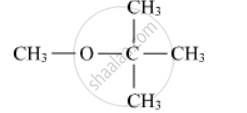
Write the structures of the products when Butan-2-ol reacts with CrO3
Write IUPAC name of the following

Isopropyl alcohol on oxidation forms:
Butane-2-ol is ____________.
IUPAC name of m-cresol is ____________.
The IUPAC name of the ether CH2 = CH–CH2OCH3 is:
Among the following sets of reactants which one produces anisole?
Which of the following compounds will react with sodium hydroxide solution in water?
Write the IUPAC name of the compound given below.
\[\begin{array}{cc}
\phantom{}\ce{CH3 - CH2 - C = C - OH}\\
\phantom{........}|\phantom{....}|\phantom{}\\
\phantom{..............}\ce{CH3 CH2OH}
\end{array}\]
Draw structure of the following compound.
2-Methoxypropane
Give the structures of Thiosulphuric acid and Peroxy monosulphuric acid.
Write IUPAC name of the following compound:
\[\begin{array}{cc}
\phantom{...............}\ce{CH3}\\
\phantom{............}|\\
\ce{CH3 - CH - CH - C - CH3}\\
|\phantom{......}|\phantom{......}|\\
\phantom{...}\ce{CH3}\phantom{...}\ce{OH}\phantom{...}\ce{CH3}
\end{array}\]
Write IUPAC names of the following compounds:
\[\begin{array}{cc}
\phantom{...............}\ce{CH3}\\
\phantom{.............}|\\
\ce{CH3 - CH - CH - C - CH3}\\
|\phantom{......}|\phantom{......}|\\
\phantom{...}\ce{CH3\phantom{...}OH\phantom{...}CH3}\\
\end{array}\]
