Advertisements
Advertisements
Question
For an experiment in Botany, two different plants, plant A and plant B were grown under similar laboratory conditions. Their heights were measured at the end of each week for 3 weeks. The results are shown by the following graph.

- How high was Plant A after (i) 2 weeks (ii) 3 weeks?
- How high was Plant B after (i) 2 weeks (ii) 3 weeks?
- How much did Plant A grow during the 3rd week?
- How much did Plant B grow from the end of the 2nd week to the end of the 3rd week?
- During which week did Plant A grow most?
- During which week did Plant B grow least?
- Were the two plants of the same height during any week shown here? Specify.
Advertisements
Solution
- After 2 weeks, the height of plant A was 7 cm.
- After 3 weeks, the height of plant A was 9 cm.
- After 2 weeks, the height of plant B was 7 cm.
- After 3 weeks, the height of plant B was 10 cm.
-
- Growth of plant A during 3rd week = 9 cm − 7 cm = 2 cm
- Growth of plant B from the end of the 2nd week to the end of the 3rd week
- = 10 cm − 7 cm = 3 cm
- Growth of plant A during 1st week = 2 cm − 0 cm = 2 cm.
- Growth of plant A during 2nd week = 7 cm − 2 cm = 5 cm.
- Growth of plant A during 3rd week = 9 cm − 7 cm = 2 cm
- Therefore, plant A grew the most, i.e. 5 cm, during the 2nd week.
- Growth of plant B during 1st week = 1 cm − 0 cm = 1 cm.
- Growth of plant B during 2nd week = 7 cm − 1 cm = 6 cm.
- Growth of plant B during 3rd week = 10 cm − 7 cm = 3 cm.
- Therefore, plant B grew the least, i.e. 1 cm, during the 1st week.
- At the end of the 2nd week, the heights of both plants were same.
RELATED QUESTIONS
The following graph shows the temperature of a patient in a hospital, recorded every hour.
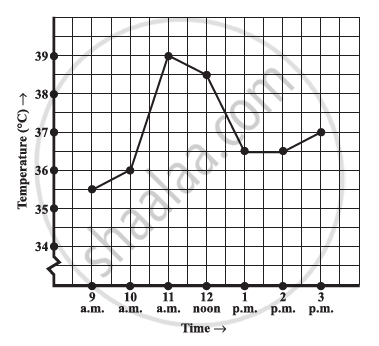
- What was the patient’s temperature at 1 p.m.?
- When was the patient’s temperature 38.5°C?
- The patient’s temperature was the same two times during the period given. What were these two times?
- What was the temperature at 1.30 p.m.? How did you arrive at your answer?
- During which periods did the patients’ temperature showed an upward trend?
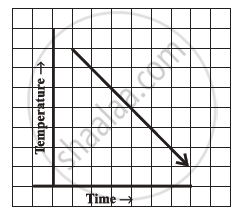
Can there be a time-temperature graph as follows? Justify your answer.
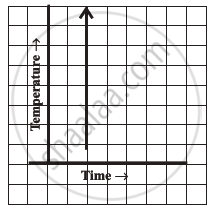
Can there be a time-temperature graph as follows? Justify your answer.
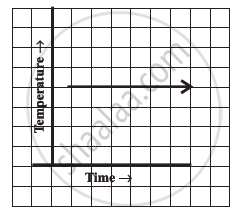
Can there be a time-temperature graph as follows? Justify your answer.
Draw the temperature-time graph in each of the following cases:
| Time (in hours): | 7:00 | 9:00 | 11:00 | 13:00 | 15:00 | 17:00 | 19:00 | 21:00 |
| Temperature (°F) in: | 100 | 101 | 104 | 102 | 100 | 99 | 100 | 98 |
Draw the temperature-time graph in each of the following cases:
| Time (in hours): | 8:00 | 10:00 | 12:00 | 14:00 | 16:00 | 18:00 | 20:00 |
| Temperature (°F) in: | 100 | 101 | 104 | 103 | 99 | 98 | 100 |
Draw the velocity-time graph from the following data:
| Time (in hours): | 7:00 | 8:00 | 9:00 | 10:00 | 11:00 | 12:00 | 13:00 | 14:00 |
| Speed (in km/hr): | 30 | 45 | 60 | 50 | 70 | 50 | 40 | 45 |
A line graph can also be a whole unbroken line.
Study the given graph and complete the corresponding table below.

Plot a line graph for the variables p and q where p is two times q i.e, the equation is p = 2q. Then find the value of q when p = 8
