Advertisements
Advertisements
Question
The following line graph shows the yearly sales figures for a manufacturing company.

- What were the sales in (i) 2002 (ii) 2006?
- What were the sales in (i) 2003 (ii) 2005?
- Compute the difference between the sales in 2002 and 2006.
- In which year was there the greatest difference between the sales as compared to its previous year?
Advertisements
Solution
- In 2002, the sales were Rs 4 crore.
- In 2006, the sales were Rs 8 crore.
- In 2003, the sales were Rs 7 crore.
- In 2005, the sales were Rs 10 crore
- sales in year 2002 = 8 crores
- Sales in year, 2006 = 4 crores
- Difference between the two = 8 − 4 = Rs 4 crore
-
- Difference between the sales of the year 2006 and 2005
= Rs (10 − 8) crores = Rs 2 crores - Difference between the sales of the year 2005 and 2004
= Rs (10 − 6) crores = Rs 4 crores - Difference between the sales of the year 2004 and 2003
= Rs (7 − 6) crore = Rs 1 crore - Difference between the sales of the year 2003 and 2002
= Rs (7 − 4) crores = Rs 3 crores
Hence, the difference was the highest in 2005 as compared to the previous year, 2004.
- Difference between the sales of the year 2006 and 2005
RELATED QUESTIONS
Use the tables below to draw linear graphs.
Population (in thousands) of men and women in a village in different years.
| Year | 2003 | 2004 | 2005 | 2006 | 2007 |
| Number of men | 12 | 12.5 | 13 | 13.2 | 13.5 |
| Number of women | 11.3 | 11.9 | 13 | 13.6 | 12.8 |
Can there be a time-temperature graph as follows? Justify your answer.
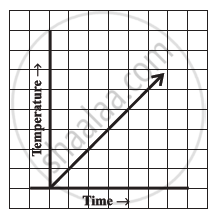
Can there be a time-temperature graph as follows? Justify your answer.
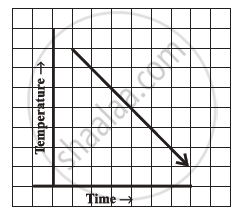
The following table shows the sales of a commodity during the years 2000 to 2006.
| Years: | 2000 | 2001 | 2002 | 2003 | 2004 | 2005 | 2006 |
| Sales (in lakhs of Rs): | 1.5 | 1.8 | 2.4 | 3.2 | 5.4 | 7.8 | 8.6 |
Draw a graph of this information.
The runs scored by two teams A and B in first 10 overs are given below:
| Overs: | I | II | III | IV | V | VI | VII | VIII | IX | X |
| Team A: | 2 | 1 | 8 | 9 | 4 | 5 | 6 | 10 | 6 | 2 |
| Team B: | 5 | 6 | 2 | 10 | 5 | 6 | 3 | 4 | 8 | 10 |
Draw a graph depicting the data, making the graphs on the same axes in each case in two different ways as a graph and as a bar chart.
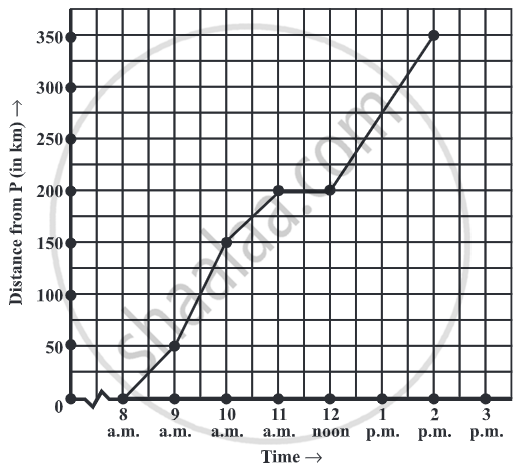
Find out from the growth chart
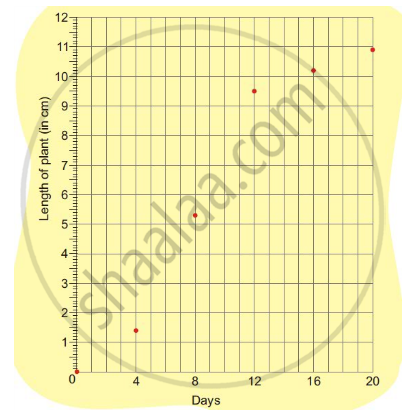
- Between which days did the length of the plant change the most?
Find out from the growth chart
- Will the plant keep growing all the time? What will be its length on the 100th day? Make a guess!
A graph that displays data that changes continuously over periods of time is ______.
Study the graph and answer the questions that follow.
- What information does the graph give?
- On which day was the temperature the least?
- On which day was the temperature 31°C?
- Which was the hottest day?

