Advertisements
Advertisements
प्रश्न
For an experiment in Botany, two different plants, plant A and plant B were grown under similar laboratory conditions. Their heights were measured at the end of each week for 3 weeks. The results are shown by the following graph.

- How high was Plant A after (i) 2 weeks (ii) 3 weeks?
- How high was Plant B after (i) 2 weeks (ii) 3 weeks?
- How much did Plant A grow during the 3rd week?
- How much did Plant B grow from the end of the 2nd week to the end of the 3rd week?
- During which week did Plant A grow most?
- During which week did Plant B grow least?
- Were the two plants of the same height during any week shown here? Specify.
Advertisements
उत्तर
- After 2 weeks, the height of plant A was 7 cm.
- After 3 weeks, the height of plant A was 9 cm.
- After 2 weeks, the height of plant B was 7 cm.
- After 3 weeks, the height of plant B was 10 cm.
-
- Growth of plant A during 3rd week = 9 cm − 7 cm = 2 cm
- Growth of plant B from the end of the 2nd week to the end of the 3rd week
- = 10 cm − 7 cm = 3 cm
- Growth of plant A during 1st week = 2 cm − 0 cm = 2 cm.
- Growth of plant A during 2nd week = 7 cm − 2 cm = 5 cm.
- Growth of plant A during 3rd week = 9 cm − 7 cm = 2 cm
- Therefore, plant A grew the most, i.e. 5 cm, during the 2nd week.
- Growth of plant B during 1st week = 1 cm − 0 cm = 1 cm.
- Growth of plant B during 2nd week = 7 cm − 1 cm = 6 cm.
- Growth of plant B during 3rd week = 10 cm − 7 cm = 3 cm.
- Therefore, plant B grew the least, i.e. 1 cm, during the 1st week.
- At the end of the 2nd week, the heights of both plants were same.
संबंधित प्रश्न
Use the tables below to draw linear graphs.
Population (in thousands) of men and women in a village in different years.
| Year | 2003 | 2004 | 2005 | 2006 | 2007 |
| Number of men | 12 | 12.5 | 13 | 13.2 | 13.5 |
| Number of women | 11.3 | 11.9 | 13 | 13.6 | 12.8 |
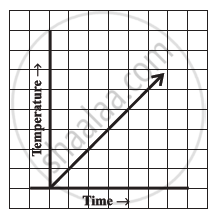
Can there be a time-temperature graph as follows? Justify your answer.
The following table shows the number of patients discharged from a hospital with HIV diagnosis in different years:
| Years: | 2002 | 2003 | 2004 | 2005 | 2006 |
| Number of patients: | 150 | 170 | 195 | 225 | 230 |
Represent this information by a graph.
The following table shows the sales of a commodity during the years 2000 to 2006.
| Years: | 2000 | 2001 | 2002 | 2003 | 2004 | 2005 | 2006 |
| Sales (in lakhs of Rs): | 1.5 | 1.8 | 2.4 | 3.2 | 5.4 | 7.8 | 8.6 |
Draw a graph of this information.
Draw the temperature-time graph in each of the following cases:
| Time (in hours): | 7:00 | 9:00 | 11:00 | 13:00 | 15:00 | 17:00 | 19:00 | 21:00 |
| Temperature (°F) in: | 100 | 101 | 104 | 102 | 100 | 99 | 100 | 98 |
The runs scored by two teams A and B in first 10 overs are given below:
| Overs: | I | II | III | IV | V | VI | VII | VIII | IX | X |
| Team A: | 2 | 1 | 8 | 9 | 4 | 5 | 6 | 10 | 6 | 2 |
| Team B: | 5 | 6 | 2 | 10 | 5 | 6 | 3 | 4 | 8 | 10 |
Draw a graph depicting the data, making the graphs on the same axes in each case in two different ways as a graph and as a bar chart.
A graph that displays data that changes continuously over periods of time is ______.
Study the given graph and complete the corresponding table below.

Plot a line graph for the variables p and q where p is two times q i.e, the equation is p = 2q. Then find.
- the value of p when q = 3
- the value of q when p = 8
Study the graph and answer the questions that follow.
- What information does the graph give?
- On which day was the temperature the least?
- On which day was the temperature 31°C?
- Which was the hottest day?

