Advertisements
Advertisements
Question
For all sets A and B, A – (A ∩ B) is equal to ______.
Advertisements
Solution
For all sets A and B, A – (A ∩ B) is equal to A ∩ B'.
Explanation:
Since A – B = A ∩ B'
⇒ A – (A ∩ B) = A ∩ B'
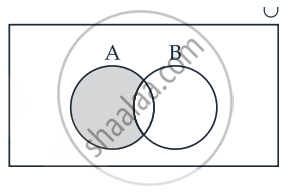
A – B = A ∩ B'
APPEARS IN
RELATED QUESTIONS
What universal set (s) would you propose for the following:
The set of isosceles triangles.
Given the sets, A = {1, 3, 5}, B = {2, 4, 6} and C = {0, 2, 4, 6, 8}, the following may be considered as universal set (s) for all the three sets A, B and C?
Φ
Given the sets, A = {1, 3, 5}, B = {2, 4, 6} and C = {0, 2, 4, 6, 8}, the following may be considered as universal set (s) for all the three sets A, B and C?
{0, 1, 2, 3, 4, 5, 6, 7, 8, 9, 10}
If U = {2, 3, 5, 7, 9} is the universal set and A = {3, 7}, B = {2, 5, 7, 9}, then prove that:
\[\left( A \cup B \right)' = A' \cap B'\]
For any two sets A and B, prove that
B ⊂ A ∪ B
For any two sets A and B, show that the following statements are equivalent:
(i) \[A \subset B\]
(ii) \[A \subset B\]=ϕ
(iii) \[A \cup B = B\]
(iv) \[A \cap B = A .\]
For three sets A, B and C, show that \[A \cap B = A \cap C\]
Find sets A, B and C such that \[A \cap B, A \cap C \text{ and } B \cap C\]are non-empty sets and\[A \cap B \cap C = \phi\]
If A and B are sets, then prove that \[A - B, A \cap B \text{ and } B - A\] are pair wise disjoint.
Using properties of sets, show that for any two sets A and B,\[\left( A \cup B \right) \cap \left( A \cap B' \right) = A\]
For any two sets of A and B, prove that:
\[A' \cup B = U \Rightarrow A \subset B\]
Each set X, contains 5 elements and each set Y, contains 2 elements and \[\cup^{20}_{r = 1} X_r = S = \cup^n_{r = 1} Y_r\] If each element of S belong to exactly 10 of the Xr's and to eactly 4 of Yr's, then find the value of n.
For any two sets A and B, prove the following:
\[A \cap \left( A' \cup B \right) = A \cap B\]
For any two sets A and B, prove the following:
\[A - \left( A - B \right) = A \cap B\]
For any two sets A and B, prove the following:
\[A \cap \left( A \cup B \right)' = \phi\]
Let A and B be two sets such that : \[n \left( A \right) = 20, n \left( A \cup B \right) = 42 \text{ and } n \left( A \cap B \right) = 4\] \[n \left( B - A \right)\]
A survey shows that 76% of the Indians like oranges, whereas 62% like bananas. What percentage of the Indians like both oranges and bananas?
In a group of 950 persons, 750 can speak Hindi and 460 can speak English. Find: how many can speak Hindi only
In a group of 950 persons, 750 can speak Hindi and 460 can speak English. Find:
how many can speak English only.
In a survey it was found that 21 persons liked product P1, 26 liked product P2 and 29 liked product P3. If 14 persons liked products P1 and P2; 12 persons liked product P3 and P1 ; 14 persons liked products P2 and P3 and 8 liked all the three products. Find how many liked product P3 only.
Let A and B be two sets that \[n \left( A \right) = 16, n \left( B \right) = 14, n \left( A \cup B \right) = 25\] Then, \[n \left( A \cap B \right)\]
If A = {1, 2, 3, 4}, B = {3, 4, 5, 6}, C = {5, 6, 7, 8} and D = {7, 8, 9, 10}; find
B ∪ D
If A = {1, 2, 3, 4}, B = {3, 4, 5, 6}, C = {5, 6, 7, 8} and D = {7, 8, 9, 10}; find
A ∪ B ∪ C
If A = {1, 2, 3, 4}, B = {3, 4, 5, 6}, C = {5, 6, 7, 8} and D = {7, 8, 9, 10}; find
B ∪ C ∪ D
If X and Y are subsets of the universal set U, then show that Y ⊂ X ∪ Y
If X and Y are subsets of the universal set U, then show that X ∩ Y ⊂ X
If A and B are subsets of the universal set U, then show that A ⊂ B ⇔ A ∪ B = B
A, B and C are subsets of Universal Set U. If A = {2, 4, 6, 8, 12, 20} B = {3, 6, 9, 12, 15}, C = {5, 10, 15, 20} and U is the set of all whole numbers, draw a Venn diagram showing the relation of U, A, B and C.
In a survey of 200 students of a school, it was found that 120 study Mathematics, 90 study Physics and 70 study Chemistry, 40 study Mathematics and Physics, 30 study Physics and Chemistry, 50 study Chemistry and Mathematics and 20 none of these subjects. Find the number of students who study all the three subjects.
In a town of 10,000 families it was found that 40% families buy newspaper A, 20% families buy newspaper B, 10% families buy newspaper C, 5% families buy A and B, 3% buy B and C and 4% buy A and C. If 2% families buy all the three newspapers. Find the number of families which buy newspaper A only.
In a town of 10,000 families it was found that 40% families buy newspaper A, 20% families buy newspaper B, 10% families buy newspaper C, 5% families buy A and B, 3% buy B and C and 4% buy A and C. If 2% families buy all the three newspapers. Find the number of families which buy none of A, B and C
If A = {1, 3, 5, 7, 9, 11, 13, 15, 17} B = {2, 4, ..., 18} and N the set of natural numbers is the universal set, then A′ ∪ (A ∪ B) ∩ B′) is ______.
