Advertisements
Advertisements
प्रश्न
For all sets A and B, A – (A ∩ B) is equal to ______.
Advertisements
उत्तर
For all sets A and B, A – (A ∩ B) is equal to A ∩ B'.
Explanation:
Since A – B = A ∩ B'
⇒ A – (A ∩ B) = A ∩ B'
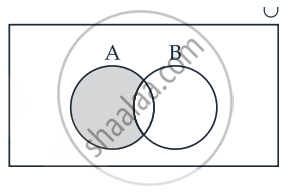
A – B = A ∩ B'
APPEARS IN
संबंधित प्रश्न
What universal set (s) would you propose for the following:
The set of right triangles.
What universal set (s) would you propose for the following:
The set of isosceles triangles.
Given the sets, A = {1, 3, 5}, B = {2, 4, 6} and C = {0, 2, 4, 6, 8}, the following may be considered as universal set (s) for all the three sets A, B and C?
{0, 1, 2, 3, 4, 5, 6}
Given the sets, A = {1, 3, 5}, B = {2, 4, 6} and C = {0, 2, 4, 6, 8}, the following may be considered as universal set (s) for all the three sets A, B and C?
Φ
Given the sets A = {1, 3, 5}, B = {2, 4, 6} and C = {0, 2, 4, 6, 8}, the following may be considered as universal set (s) for all the three sets A, B and C?
{1, 2, 3, 4, 5, 6, 7, 8}
For any two sets A and B, prove that
B ⊂ A ∪ B
For three sets A, B and C, show that \[A \subset B \Rightarrow C - B \subset C - A\]
For any two sets, prove that:
\[A \cap \left( A \cup B \right) = A\]
Find sets A, B and C such that \[A \cap B, A \cap C \text{ and } B \cap C\]are non-empty sets and\[A \cap B \cap C = \phi\]
If A and B are sets, then prove that \[A - B, A \cap B \text{ and } B - A\] are pair wise disjoint.
For any two sets of A and B, prove that:
\[A' \cup B = U \Rightarrow A \subset B\]
For any two sets of A and B, prove that:
\[B' \subset A' \Rightarrow A \subset B\]
Show that for any sets A and B, A ∪ (B – A) = (A ∪ B)
For any two sets A and B, prove that :
\[A' - B' = B - A\]
For any two sets A and B, prove the following:
\[A - \left( A - B \right) = A \cap B\]
For any two sets A and B, prove the following:
\[A \cap \left( A \cup B \right)' = \phi\]
For any two sets A and B, prove the following:
\[A - B = A \Delta\left( A \cap B \right)\]
A survey shows that 76% of the Indians like oranges, whereas 62% like bananas. What percentage of the Indians like both oranges and bananas?
In a survey it was found that 21 persons liked product P1, 26 liked product P2 and 29 liked product P3. If 14 persons liked products P1 and P2; 12 persons liked product P3 and P1 ; 14 persons liked products P2 and P3 and 8 liked all the three products. Find how many liked product P3 only.
Let U be the universal set containing 700 elements. If A, B are sub-sets of U such that \[n \left( A \right) = 200, n \left( B \right) = 300 \text{ and } \left( A \cap B \right) = 100\].Then \[n \left( A' \cap B' \right) =\]
If A = {1, 2, 3, 4}, B = {3, 4, 5, 6}, C = {5, 6, 7, 8} and D = {7, 8, 9, 10}; find
B ∪ D
If A = {1, 2, 3, 4}, B = {3, 4, 5, 6}, C = {5, 6, 7, 8} and D = {7, 8, 9, 10}; find
A ∪ B ∪ C
If X and Y are subsets of the universal set U, then show that X ∩ Y ⊂ X
If A and B are subsets of the universal set U, then show that (A ∩ B) ⊂ A
A, B and C are subsets of Universal Set U. If A = {2, 4, 6, 8, 12, 20} B = {3, 6, 9, 12, 15}, C = {5, 10, 15, 20} and U is the set of all whole numbers, draw a Venn diagram showing the relation of U, A, B and C.
Let A, B and C be sets. Then show that A ∩ (B ∪ C) = (A ∩ B) ∪ (A ∩ C)
If A = {1, 3, 5, 7, 9, 11, 13, 15, 17} B = {2, 4, ..., 18} and N the set of natural numbers is the universal set, then A′ ∪ (A ∪ B) ∩ B′) is ______.
Match the following sets for all sets A, B, and C.
| Column A | Column B |
| (i) ((A′ ∪ B′) – A)′ | (a) A – B |
| (ii) [B′ ∪ (B′ – A)]′ | (b) A |
| (iii) (A – B) – (B – C) | (c) B |
| (iv) (A – B) ∩ (C – B) | (d) (A × B) ∩ (A × C) |
| (v) A × (B ∩ C) | (e) (A × B) ∪ (A × C) |
| (vi) A × (B ∪ C) | (f) (A ∩ C) – B |
