Advertisements
Advertisements
Question
Find the equation of lines passing through (1, 2) and making angle 30° with y-axis.
Advertisements
Solution
Given that the line makes angle 30° with y-axis
∴ Angle made by the line with x-axis is 60°
∴ Slope of the line
m = tan 60°
⇒ m = `sqrt(3)`
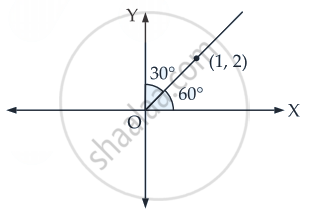
So, the equation of the line passing through the point (1, 2)
And slope `sqrt(3)` is y – y1 = m(x – x1)
⇒ y – 2 = `sqrt(3)(x - 1)`
⇒ y – 2 = `sqrt(3)(x - 1)`
⇒ `y - sqrt(3)x + sqrt(3) - 2` = 0
Hence, the required equation of line is `y - sqrt(3)x + sqrt(3) - 2` = 0
APPEARS IN
RELATED QUESTIONS
Find the equation of the straight lines passing through the following pair of point :
(0, 0) and (2, −2)
Find the equation of the straight lines passing through the following pair of point:
(a, b) and (a + c sin α, b + c cos α)
Find the equation of the straight lines passing through the following pair of point :
(0, −a) and (b, 0)
Find the equation of the straight lines passing through the following pair of point :
(a, b) and (a + b, a − b)
Find the equation of the straight lines passing through the following pair of point :
(at1, a/t1) and (at2, a/t2)
Find the equations to the diagonals of the rectangle the equations of whose sides are x = a, x = a', y= b and y = b'.
Find the equation to the straight line which bisects the distance between the points (a, b), (a', b') and also bisects the distance between the points (−a, b) and (a', −b').
The vertices of a quadrilateral are A (−2, 6), B (1, 2), C (10, 4), and D (7, 8). Find the equation of its diagonals.
Find the equations to the straight lines which go through the origin and trisect the portion of the straight line 3 x + y = 12 which is intercepted between the axes of coordinates.
Find the equation to the straight line cutting off intercepts 3 and 2 from the axes.
Find the equation to the straight line cutting off intercepts − 5 and 6 from the axes.
Find the equation of the straight line which passes through (1, −2) and cuts off equal intercepts on the axes.
Find the equation of the line, which passes through P (1, −7) and meets the axes at A and Brespectively so that 4 AP − 3 BP = 0.
Find the equations of the straight lines which pass through the origin and trisect the portion of the straight line 2x + 3y = 6 which is intercepted between the axes.
Find the equation of the straight line passing through the point (2, 1) and bisecting the portion of the straight line 3x − 5y = 15 lying between the axes.
The straight line through P (x1, y1) inclined at an angle θ with the x-axis meets the line ax + by + c = 0 in Q. Find the length of PQ.
Find the equation of the line passing through the point of intersection of the lines 4x − 7y − 3 = 0 and 2x − 3y + 1 = 0 that has equal intercepts on the axes.
If the straight line \[\frac{x}{a} + \frac{y}{b} = 1\] passes through the point of intersection of the lines x + y = 3 and 2x − 3y = 1 and is parallel to x − y − 6 = 0, find a and b.
Find the equation of the line passing through the intersection of the lines 2x + y = 5 and x + 3y + 8 = 0 and parallel to the line 3x + 4y = 7.
Find the equation of the straight line passing through the point of intersection of the lines 5x − 6y − 1 = 0 and 3x + 2y + 5 = 0 and perpendicular to the line 3x − 5y + 11 = 0 .
Find the equation of a line passing through the point (2, 3) and parallel to the line 3x − 4y + 5 = 0.
Find the length of the perpendicular from the point (4, −7) to the line joining the origin and the point of intersection of the lines 2x − 3y + 14 = 0 and 5x + 4y − 7 = 0.
Find the equation of the straight lines passing through the origin and making an angle of 45° with the straight line \[\sqrt{3}x + y = 11\].
Find the equations to the straight lines which pass through the origin and are inclined at an angle of 75° to the straight line \[x + y + \sqrt{3}\left( y - x \right) = a\].
The equation of one side of an equilateral triangle is x − y = 0 and one vertex is \[(2 + \sqrt{3}, 5)\]. Prove that a second side is \[y + (2 - \sqrt{3}) x = 6\] and find the equation of the third side.
The equation of the base of an equilateral triangle is x + y = 2 and its vertex is (2, −1). Find the length and equations of its sides.
Find the equation of the straight line drawn through the point of intersection of the lines x + y = 4 and 2x − 3y = 1 and perpendicular to the line cutting off intercepts 5, 6 on the axes.
Prove that the family of lines represented by x (1 + λ) + y (2 − λ) + 5 = 0, λ being arbitrary, pass through a fixed point. Also, find the fixed point.
Find the equation of the straight line passing through the point of intersection of 2x + y − 1 = 0 and x + 3y − 2 = 0 and making with the coordinate axes a triangle of area \[\frac{3}{8}\] sq. units.
Write the equation of the line passing through the point (1, −2) and cutting off equal intercepts from the axes.
The equation of the straight line which passes through the point (−4, 3) such that the portion of the line between the axes is divided internally by the point in the ratio 5 : 3 is
If the point (5, 2) bisects the intercept of a line between the axes, then its equation is
The equations of the lines which pass through the point (3, –2) and are inclined at 60° to the line `sqrt(3) x + y` = 1 is ______.
Equation of the line passing through the point (a cos3θ, a sin3θ) and perpendicular to the line x sec θ + y cosec θ = a is x cos θ – y sin θ = a sin 2θ.
The straight line 5x + 4y = 0 passes through the point of intersection of the straight lines x + 2y – 10 = 0 and 2x + y + 5 = 0.
The equation of the line joining the point (3, 5) to the point of intersection of the lines 4x + y – 1 = 0 and 7x – 3y – 35 = 0 is equidistant from the points (0, 0) and (8, 34).
The lines ax + 2y + 1 = 0, bx + 3y + 1 = 0 and cx + 4y + 1 = 0 are concurrent if a, b, c are in G.P.
