Advertisements
Advertisements
Question
Find the equations of the circles touching y-axis at (0, 3) and making an intercept of 8 units on the X-axis.
Advertisements
Solution
Case I: The centre lies in first quadrant.
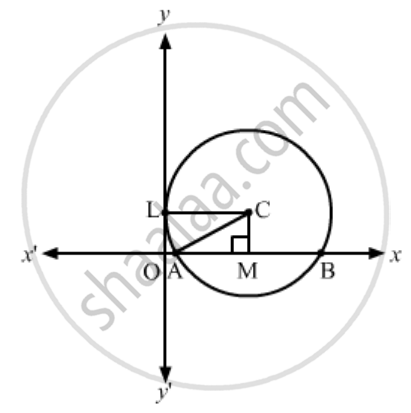
Let the required equation be
In \[\bigtriangleup\]CAM:
\[ \Rightarrow CA = 5\]
\[ \Rightarrow CL = CA = 5\]
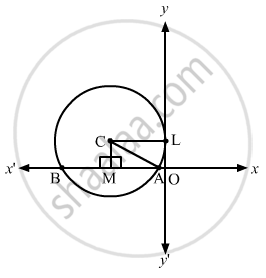
APPEARS IN
RELATED QUESTIONS
Find the equation of the circle with:
Centre (a, b) and radius\[\sqrt{a^2 + b^2}\]
Find the equation of the circle with:
Centre (0, −1) and radius 1.
Find the centre and radius of each of the following circles:
(x − 1)2 + y2 = 4
Find the centre and radius of each of the following circles:
(x + 5)2 + (y + 1)2 = 9
Find the equation of a circle
which touches both the axes and passes through the point (2, 1).
Find the equation of a circle
passing through the origin, radius 17 and ordinate of the centre is −15.
Find the equation of the circle which has its centre at the point (3, 4) and touches the straight line 5x + 12y − 1 = 0.
Find the equation of the circle having (1, −2) as its centre and passing through the intersection of the lines 3x + y = 14 and 2x + 5y = 18.
One diameter of the circle circumscribing the rectangle ABCD is 4y = x + 7. If the coordinates of A and B are (−3, 4) and (5, 4) respectively, find the equation of the circle.
Find the coordinates of the centre and radius of each of the following circles: x2 + y2 + 6x − 8y − 24 = 0
Find the coordinates of the centre and radius of the following circle:
1/2 (x2 + y2) + x cos θ + y sin θ − 4 = 0
Find the equation of the circle which circumscribes the triangle formed by the lines x + y + 3 = 0, x − y + 1 = 0 and x = 3
Find the equation to the circle which passes through the points (1, 1) (2, 2) and whose radius is 1. Show that there are two such circles.
Find the equation of the circle concentric with x2 + y2 − 4x − 6y − 3 = 0 and which touches the y-axis.
Find the equation of the circle circumscribing the rectangle whose sides are x − 3y = 4, 3x + y = 22, x − 3y = 14 and 3x + y = 62.
Find the equation of the circle whose diameter is the line segment joining (−4, 3) and (12, −1). Find also the intercept made by it on y-axis.
The line 2x − y + 6 = 0 meets the circle x2 + y2 − 2y − 9 = 0 at A and B. Find the equation of the circle on AB as diameter.
Find the equation of the circle which circumscribes the triangle formed by the lines x = 0, y = 0 and lx + my = 1.
If the abscissae and ordinates of two points P and Q are roots of the equations x2 + 2ax − b2 = 0 and x2 + 2px − q2 = 0 respectively, then write the equation of the circle with PQ as diameter.
If the radius of the circle x2 + y2 + ax + (1 − a) y + 5 = 0 does not exceed 5, write the number of integral values a.
Write the area of the circle passing through (−2, 6) and having its centre at (1, 2).
If the equation of a circle is λx2 + (2λ − 3) y2 − 4x + 6y − 1 = 0, then the coordinates of centre are
If 2x2 + λxy + 2y2 + (λ − 4) x + 6y − 5 = 0 is the equation of a circle, then its radius is
The radius of the circle represented by the equation 3x2 + 3y2 + λxy + 9x + (λ − 6) y + 3 = 0 is
The number of integral values of λ for which the equation x2 + y2 + λx + (1 − λ) y + 5 = 0 is the equation of a circle whose radius cannot exceed 5, is
The equation of the incircle formed by the coordinate axes and the line 4x + 3y = 6 is
If the circles x2 + y2 = 9 and x2 + y2 + 8y + c = 0 touch each other, then c is equal to
The equation of a circle with radius 5 and touching both the coordinate axes is
The equation of the circle passing through the origin which cuts off intercept of length 6 and 8 from the axes is
The circle x2 + y2 + 2gx + 2fy + c = 0 does not intersect x-axis, if
The equation of the circle which touches the axes of coordinates and the line \[\frac{x}{3} + \frac{y}{4} = 1\] and whose centres lie in the first quadrant is x2 + y2 − 2cx − 2cy + c2 = 0, where c is equal to
Equation of the diameter of the circle x2 + y2 − 2x + 4y = 0 which passes through the origin is
Equation of the circle through origin which cuts intercepts of length a and b on axes is
If the circles x2 + y2 + 2ax + c = 0 and x2 + y2 + 2by + c = 0 touch each other, then
