Advertisements
Advertisements
प्रश्न
Find the equations of the circles touching y-axis at (0, 3) and making an intercept of 8 units on the X-axis.
Advertisements
उत्तर
Case I: The centre lies in first quadrant.
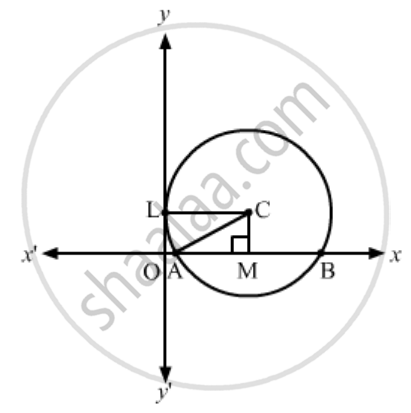
Let the required equation be
In \[\bigtriangleup\]CAM:
\[ \Rightarrow CA = 5\]
\[ \Rightarrow CL = CA = 5\]
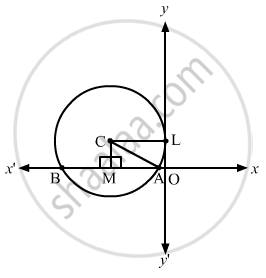
APPEARS IN
संबंधित प्रश्न
Find the equation of the circle with:
Centre (−2, 3) and radius 4.
Find the equation of the circle with:
Centre (a, b) and radius\[\sqrt{a^2 + b^2}\]
Find the equation of a circle
passing through the origin, radius 17 and ordinate of the centre is −15.
A circle whose centre is the point of intersection of the lines 2x − 3y + 4 = 0 and 3x + 4y− 5 = 0 passes through the origin. Find its equation.
If the line y = \[\sqrt{3}\] x + k touches the circle x2 + y2 = 16, then find the value of k.
Find the equation of the circle having (1, −2) as its centre and passing through the intersection of the lines 3x + y = 14 and 2x + 5y = 18.
If the lines 3x − 4y + 4 = 0 and 6x − 8y − 7 = 0 are tangents to a circle, then find the radius of the circle.
The circle x2 + y2 − 2x − 2y + 1 = 0 is rolled along the positive direction of x-axis and makes one complete roll. Find its equation in new-position.
Find the coordinates of the centre and radius of each of the following circles: x2 + y2 + 6x − 8y − 24 = 0
Find the coordinates of the centre and radius of each of the following circles: x2 + y2 − ax − by = 0
Find the equation of the circle passing through the points:
(5, 7), (8, 1) and (1, 3)
Find the equation of the circle which passes through (3, −2), (−2, 0) and has its centre on the line 2x − y = 3.
Find the equation of the circle which circumscribes the triangle formed by the lines 2x + y − 3 = 0, x + y − 1 = 0 and 3x + 2y − 5 = 0
Find the equation of the circle which circumscribes the triangle formed by the lines
x + y = 2, 3x − 4y = 6 and x − y = 0.
Prove that the centres of the three circles x2 + y2 − 4x − 6y − 12 = 0, x2 + y2 + 2x + 4y − 10 = 0 and x2 + y2 − 10x − 16y − 1 = 0 are collinear.
Prove that the radii of the circles x2 + y2 = 1, x2 + y2 − 2x − 6y − 6 = 0 and x2 + y2 − 4x − 12y − 9 = 0 are in A.P.
Find the equation of the circle which passes through the origin and cuts off chords of lengths 4 and 6 on the positive side of the x-axis and y-axis respectively.
Find the equation of the circle concentric with the circle x2 + y2 − 6x + 12y + 15 = 0 and double of its area.
Find the equation of the circle concentric with x2 + y2 − 4x − 6y − 3 = 0 and which touches the y-axis.
Find the equation of the circle, the end points of whose diameter are (2, −3) and (−2, 4). Find its centre and radius.
The sides of a square are x = 6, x = 9, y = 3 and y = 6. Find the equation of a circle drawn on the diagonal of the square as its diameter.
Find the equation of the circle passing through the origin and the points where the line 3x + 4y = 12 meets the axes of coordinates.
Find the equation of the circle which passes through the origin and cuts off intercepts aand b respectively from x and y - axes.
The line 2x − y + 6 = 0 meets the circle x2 + y2 − 2y − 9 = 0 at A and B. Find the equation of the circle on AB as diameter.
Find the equations of the circles which pass through the origin and cut off equal chords of \[\sqrt{2}\] units from the lines y = x and y = − x.
If the abscissae and ordinates of two points P and Q are roots of the equations x2 + 2ax − b2 = 0 and x2 + 2px − q2 = 0 respectively, then write the equation of the circle with PQ as diameter.
Write the area of the circle passing through (−2, 6) and having its centre at (1, 2).
If the equation (4a − 3) x2 + ay2 + 6x − 2y + 2 = 0 represents a circle, then its centre is ______.
The radius of the circle represented by the equation 3x2 + 3y2 + λxy + 9x + (λ − 6) y + 3 = 0 is
The equation of the incircle formed by the coordinate axes and the line 4x + 3y = 6 is
The equation of the circle passing through the origin which cuts off intercept of length 6 and 8 from the axes is
If the circles x2 + y2 + 2ax + c = 0 and x2 + y2 + 2by + c = 0 touch each other, then
