Advertisements
Advertisements
प्रश्न
The equation of the circle circumscribing the triangle whose sides are the lines y = x + 2, 3y = 4x, 2y = 3x is ______.
Advertisements
उत्तर
The equation of the circle circumscribing the triangle whose sides are the lines y = x + 2, 3y = 4x, 2y = 3x is x2 + y2 – 46x + 22y = 0
Explanation: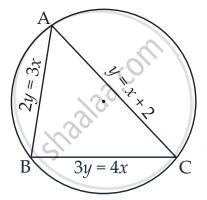
Let AB represents 2y = 3x ......(i)
BC represents 3y = 4x ......(ii)
And AC represents y = x + 2 .......(iii)
From equation (i) and (ii)
2y = 3x
⇒ y = `(3x)/2`
Putting the value of y in equation (ii) we get
`3((3x)/2) = 4x`
⇒ 9x = 8x
⇒ x = 0 and y = 0
From equation (i) and (iii) we get
y = x + 2
Putting y = x + 2 in equation (i) we get
2(x + 2) = 3x
⇒ 2x + 4 = 3x
⇒ x = 4 and y = 6
∴ Coordinates of B = (0, 0)
From equation (i) and (iii) we get
y = x + 2
Putting y = x + 2 in equation (i) we get
2(x + 2) = 3x
⇒ 2x + 4 = 3x
⇒ x = 4 and y = 6
∴ Coordinates of A = (4, 6)
Solving equation (ii) and (iii) we get
y = x + 2
Putting the value of y in equation (ii) we get
3(x + 2) = 4x
⇒ 3x + 6 = 4x
⇒ x = 6 and y = 8
∴ Coordinates of C = (6, 8)
It implies that the circle is passing through (0, 0), (4, 6) and (6, 8).
We know that the general equation of the circle is
x2 + y2 + 2gx + 2fy + c = 0 ......(i)
Since the points (0, 0), (4, 6) and (6, 8) lie on the circle then
0 + 0 + 0 + 0 + c = 0
⇒ c = 0
16 + 36 + 8g + 12f + c = 0
⇒ 8g + 12f + 0 = – 52
⇒ 2g + 3f = – 13 ......(ii)
And 36 + 64 + 12g + 16f + c = 0
⇒ 12g + 16f + 0 = – 100
⇒ 3g + 4f = – 25 .......(iii)
Solving equation (ii) and (iii) we get
2g + 3f = – 13
3g + 4f = – 25
⇒ 6g + 9f = – 39
6g + 8f = – 50
(–) (–) (+)
f = 11
Putting the value of f in equation (ii) we get
2g + 3 × 11 = – 13
⇒ 2g + 33 = – 13
⇒ 2g = – 46
⇒ g = – 23
Putting the values of g, f and c in equation (i) we get
x2 + y2 + 2(– 23)x + 2(11)y + 0 = 0
⇒ x2 + y2 – 46x + 22y = 0
APPEARS IN
संबंधित प्रश्न
Find the equation of the circle with:
Centre (−2, 3) and radius 4.
Find the equation of the circle with:
Centre (a, b) and radius\[\sqrt{a^2 + b^2}\]
Find the equation of the circle with:
Centre (0, −1) and radius 1.
Find the centre and radius of each of the following circles:
(x − 1)2 + y2 = 4
Find the centre and radius of each of the following circles:
x2 + y2 − 4x + 6y = 5
Find the equation of the circle whose centre lies on the positive direction of y - axis at a distance 6 from the origin and whose radius is 4.
Find the equation of a circle
which touches both the axes at a distance of 6 units from the origin.
Find the equation of a circle which touches x-axis at a distance 5 from the origin and radius 6 units.
Find the equation of the circle which has its centre at the point (3, 4) and touches the straight line 5x + 12y − 1 = 0.
Find the equation of the circle which touches the axes and whose centre lies on x − 2y = 3.
Find the equations of the circles passing through two points on Y-axis at distances 3 from the origin and having radius 5.
If the lines 2x − 3y = 5 and 3x − 4y = 7 are the diameters of a circle of area 154 square units, then obtain the equation of the circle.
Find the equation of the circle having (1, −2) as its centre and passing through the intersection of the lines 3x + y = 14 and 2x + 5y = 18.
Show that the point (x, y) given by \[x = \frac{2at}{1 + t^2}\] and \[y = a\left( \frac{1 - t^2}{1 + t^2} \right)\] lies on a circle for all real values of t such that \[- 1 \leq t \leq 1\] where a is any given real number.
The circle x2 + y2 − 2x − 2y + 1 = 0 is rolled along the positive direction of x-axis and makes one complete roll. Find its equation in new-position.
Find the coordinates of the centre and radius of each of the following circles: 2x2 + 2y2 − 3x + 5y = 7
Find the coordinates of the centre and radius of the following circle:
1/2 (x2 + y2) + x cos θ + y sin θ − 4 = 0
Find the equation of the circle which passes through (3, −2), (−2, 0) and has its centre on the line 2x − y = 3.
Show that the points (3, −2), (1, 0), (−1, −2) and (1, −4) are concyclic.
Find the equation of the circle which circumscribes the triangle formed by the lines 2x + y − 3 = 0, x + y − 1 = 0 and 3x + 2y − 5 = 0
Find the equation of the circle concentric with the circle x2 + y2 − 6x + 12y + 15 = 0 and double of its area.
If a circle passes through the point (0, 0),(a, 0),(0, b) then find the coordinates of its centre.
Find the equation of the circle, the end points of whose diameter are (2, −3) and (−2, 4). Find its centre and radius.
Find the equation of the circle the end points of whose diameter are the centres of the circles x2 + y2 + 6x − 14y − 1 = 0 and x2 + y2 − 4x + 10y − 2 = 0.
The sides of a square are x = 6, x = 9, y = 3 and y = 6. Find the equation of a circle drawn on the diagonal of the square as its diameter.
Find the equation of the circle circumscribing the rectangle whose sides are x − 3y = 4, 3x + y = 22, x − 3y = 14 and 3x + y = 62.
Find the equation of the circle which passes through the origin and cuts off intercepts aand b respectively from x and y - axes.
Write the length of the intercept made by the circle x2 + y2 + 2x − 4y − 5 = 0 on y-axis.
If the abscissae and ordinates of two points P and Q are roots of the equations x2 + 2ax − b2 = 0 and x2 + 2px − q2 = 0 respectively, then write the equation of the circle with PQ as diameter.
The equation of the incircle formed by the coordinate axes and the line 4x + 3y = 6 is
If the circles x2 + y2 = 9 and x2 + y2 + 8y + c = 0 touch each other, then c is equal to
If the circle x2 + y2 + 2ax + 8y + 16 = 0 touches x-axis, then the value of a is
The equation of the circle which touches the axes of coordinates and the line \[\frac{x}{3} + \frac{y}{4} = 1\] and whose centres lie in the first quadrant is x2 + y2 − 2cx − 2cy + c2 = 0, where c is equal to
If the circles x2 + y2 = a and x2 + y2 − 6x − 8y + 9 = 0, touch externally, then a =
Equation of the circle through origin which cuts intercepts of length a and b on axes is
Equation of the circle with centre on the y-axis and passing through the origin and the point (2, 3) is ______.
