Advertisements
Advertisements
Question
The equation of a circle with origin as centre and passing through the vertices of an equilateral triangle whose median is of length 3a is ______.
Options
x2 + y2 = 9a2
x2 + y2 = 16a2
x2 + y2 = 4a2
x2 + y2 = a2
Advertisements
Solution
The equation of a circle with origin as centre and passing through the vertices of an equilateral triangle whose median is of length 3a is x2 + y2 = 4a2.
Explanation: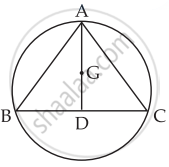
Let ABC be an equilateral triangle in which median AD = 3a.
Centre of the circle is same as the centroid of the triangle
i.e., (0, 0)
AG : GD = 2 : 1
So, AG = `2/3` AD = `2/3 xx 3a = 2a`
∴ The equation of the circle is (x – 0)2 + (y – 0)2 = (2a)2
⇒ x2 + y2 = 4a2
APPEARS IN
RELATED QUESTIONS
Find the equation of the circle with:
Centre (a, a) and radius \[\sqrt{2}\]a.
Find the centre and radius of each of the following circles:
x2 + y2 − 4x + 6y = 5
Find the equation of the circle whose centre lies on the positive direction of y - axis at a distance 6 from the origin and whose radius is 4.
If the equations of two diameters of a circle are 2x + y = 6 and 3x + 2y = 4 and the radius is 10, find the equation of the circle.
Find the equations of the circles touching y-axis at (0, 3) and making an intercept of 8 units on the X-axis.
Find the equations of the circles passing through two points on Y-axis at distances 3 from the origin and having radius 5.
If the line y = \[\sqrt{3}\] x + k touches the circle x2 + y2 = 16, then find the value of k.
Show that the point (x, y) given by \[x = \frac{2at}{1 + t^2}\] and \[y = a\left( \frac{1 - t^2}{1 + t^2} \right)\] lies on a circle for all real values of t such that \[- 1 \leq t \leq 1\] where a is any given real number.
Find the equation of the circle which circumscribes the triangle formed by the lines
x + y = 2, 3x − 4y = 6 and x − y = 0.
Prove that the centres of the three circles x2 + y2 − 4x − 6y − 12 = 0, x2 + y2 + 2x + 4y − 10 = 0 and x2 + y2 − 10x − 16y − 1 = 0 are collinear.
Find the equation of the circle which passes through the origin and cuts off chords of lengths 4 and 6 on the positive side of the x-axis and y-axis respectively.
Find the equation of the circle concentric with the circle x2 + y2 − 6x + 12y + 15 = 0 and double of its area.
Find the equation of the circle concentric with x2 + y2 − 4x − 6y − 3 = 0 and which touches the y-axis.
If a circle passes through the point (0, 0),(a, 0),(0, b) then find the coordinates of its centre.
Find the equation of the circle, the end points of whose diameter are (2, −3) and (−2, 4). Find its centre and radius.
Find the equation of the circle the end points of whose diameter are the centres of the circles x2 + y2 + 6x − 14y − 1 = 0 and x2 + y2 − 4x + 10y − 2 = 0.
Find the equation of the circle circumscribing the rectangle whose sides are x − 3y = 4, 3x + y = 22, x − 3y = 14 and 3x + y = 62.
Find the equation of the circle passing through the origin and the points where the line 3x + 4y = 12 meets the axes of coordinates.
The abscissae of the two points A and B are the roots of the equation x2 + 2ax − b2 = 0 and their ordinates are the roots of the equation x2 + 2px − q2 = 0. Find the equation of the circle with AB as diameter. Also, find its radius.
ABCD is a square whose side is a; taking AB and AD as axes, prove that the equation of the circle circumscribing the square is x2 + y2 − a (x + y) = 0.
Write the equation of the unit circle concentric with x2 + y2 − 8x + 4y − 8 = 0.
If the radius of the circle x2 + y2 + ax + (1 − a) y + 5 = 0 does not exceed 5, write the number of integral values a.
Write the area of the circle passing through (−2, 6) and having its centre at (1, 2).
The equation of the circle passing through the point (1, 1) and having two diameters along the pair of lines x2 − y2 −2x + 4y − 3 = 0, is
If the point (2, k) lies outside the circles x2 + y2 + x − 2y − 14 = 0 and x2 + y2 = 13 then k lies in the interval
If the point (λ, λ + 1) lies inside the region bounded by the curve \[x = \sqrt{25 - y^2}\] and y-axis, then λ belongs to the interval
If the circles x2 + y2 = 9 and x2 + y2 + 8y + c = 0 touch each other, then c is equal to
The circle x2 + y2 + 2gx + 2fy + c = 0 does not intersect x-axis, if
The area of an equilateral triangle inscribed in the circle x2 + y2 − 6x − 8y − 25 = 0 is
The equation of the circle which touches the axes of coordinates and the line \[\frac{x}{3} + \frac{y}{4} = 1\] and whose centres lie in the first quadrant is x2 + y2 − 2cx − 2cy + c2 = 0, where c is equal to
If the circles x2 + y2 = a and x2 + y2 − 6x − 8y + 9 = 0, touch externally, then a =
If (−3, 2) lies on the circle x2 + y2 + 2gx + 2fy + c = 0 which is concentric with the circle x2 + y2 + 6x + 8y − 5 = 0, then c =
Equation of the diameter of the circle x2 + y2 − 2x + 4y = 0 which passes through the origin is
Equation of the circle through origin which cuts intercepts of length a and b on axes is
