Advertisements
Advertisements
Question
If the centroid of an equilateral triangle is (1, 1) and its one vertex is (−1, 2), then the equation of its circumcircle is
Options
x2 + y2 − 2x − 2y − 3 = 0
x2 + y2 + 2x − 2y − 3 = 0
x2 + y2 + 2x + 2y − 3 = 0
none of these
Advertisements
Solution
x2 + y2 − 2x − 2y − 3 = 0
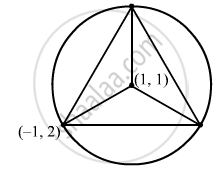
The centre of the circumcircle is (1, 1).
Radius of the circumcircle = \[\sqrt{\left( 1 + 1 \right)^2 + \left( 1 - 2 \right)^2} = \sqrt{5}\]
∴ Equation of the circle: \[\left( x - 1 \right)^2 + \left( y - 1 \right)^2 = 5\]
\[\Rightarrow x^2 + y^2 - 2x - 2y - 3 = 0\]
APPEARS IN
RELATED QUESTIONS
Find the equation of the circle with:
Centre (a, b) and radius\[\sqrt{a^2 + b^2}\]
Find the equation of the circle with:
Centre (a, a) and radius \[\sqrt{2}\]a.
Find the centre and radius of each of the following circles:
(x + 5)2 + (y + 1)2 = 9
Find the centre and radius of each of the following circles:
x2 + y2 − 4x + 6y = 5
Find the equation of a circle which touches x-axis at a distance 5 from the origin and radius 6 units.
Find the equation of a circle
passing through the origin, radius 17 and ordinate of the centre is −15.
Find the equations of the circles passing through two points on Y-axis at distances 3 from the origin and having radius 5.
If the lines 2x − 3y = 5 and 3x − 4y = 7 are the diameters of a circle of area 154 square units, then obtain the equation of the circle.
If the line y = \[\sqrt{3}\] x + k touches the circle x2 + y2 = 16, then find the value of k.
Find the coordinates of the centre and radius of the following circle:
1/2 (x2 + y2) + x cos θ + y sin θ − 4 = 0
Find the equation of the circle which circumscribes the triangle formed by the lines x + y + 3 = 0, x − y + 1 = 0 and x = 3
Find the equation of the circle which circumscribes the triangle formed by the lines
x + y = 2, 3x − 4y = 6 and x − y = 0.
Find the equation of the circle which circumscribes the triangle formed by the lines y = x + 2, 3y = 4x and 2y = 3x.
Find the equation to the circle which passes through the points (1, 1) (2, 2) and whose radius is 1. Show that there are two such circles.
Find the equation of the circle which passes through the points (2, 3) and (4,5) and the centre lies on the straight line y − 4x + 3 = 0.
Find the equation of the circle, the end points of whose diameter are (2, −3) and (−2, 4). Find its centre and radius.
Find the equation of the circle the end points of whose diameter are the centres of the circles x2 + y2 + 6x − 14y − 1 = 0 and x2 + y2 − 4x + 10y − 2 = 0.
The sides of a square are x = 6, x = 9, y = 3 and y = 6. Find the equation of a circle drawn on the diagonal of the square as its diameter.
Find the equation of the circle whose diameter is the line segment joining (−4, 3) and (12, −1). Find also the intercept made by it on y-axis.
ABCD is a square whose side is a; taking AB and AD as axes, prove that the equation of the circle circumscribing the square is x2 + y2 − a (x + y) = 0.
Find the equations of the circles which pass through the origin and cut off equal chords of \[\sqrt{2}\] units from the lines y = x and y = − x.
Write the length of the intercept made by the circle x2 + y2 + 2x − 4y − 5 = 0 on y-axis.
If the abscissae and ordinates of two points P and Q are roots of the equations x2 + 2ax − b2 = 0 and x2 + 2px − q2 = 0 respectively, then write the equation of the circle with PQ as diameter.
Write the equation of the unit circle concentric with x2 + y2 − 8x + 4y − 8 = 0.
If the equation of a circle is λx2 + (2λ − 3) y2 − 4x + 6y − 1 = 0, then the coordinates of centre are
If 2x2 + λxy + 2y2 + (λ − 4) x + 6y − 5 = 0 is the equation of a circle, then its radius is
The equation x2 + y2 + 2x − 4y + 5 = 0 represents
The radius of the circle represented by the equation 3x2 + 3y2 + λxy + 9x + (λ − 6) y + 3 = 0 is
The equation of the circle passing through the point (1, 1) and having two diameters along the pair of lines x2 − y2 −2x + 4y − 3 = 0, is
If the point (λ, λ + 1) lies inside the region bounded by the curve \[x = \sqrt{25 - y^2}\] and y-axis, then λ belongs to the interval
If the circles x2 + y2 = 9 and x2 + y2 + 8y + c = 0 touch each other, then c is equal to
The equation of the circle which touches the axes of coordinates and the line \[\frac{x}{3} + \frac{y}{4} = 1\] and whose centres lie in the first quadrant is x2 + y2 − 2cx − 2cy + c2 = 0, where c is equal to
If the circles x2 + y2 = a and x2 + y2 − 6x − 8y + 9 = 0, touch externally, then a =
Equation of the circle through origin which cuts intercepts of length a and b on axes is
The equation of the circle circumscribing the triangle whose sides are the lines y = x + 2, 3y = 4x, 2y = 3x is ______.
