Advertisements
Advertisements
Questions
Distinguish between the free (or natural) and forced vibrations.
State two ways in which natural vibrations differ from forced vibrations.
Advertisements
Solution
| Natural Vibration | Forced Vibration | |
| i. | An object's natural vibrations are its inherent vibrations, which occur at a consistent amplitude and frequency. |
Forced vibrations are those that occur as a result of being subjected to a periodic external force. |
| ii. | The amplitude changes with time. | Amplitude doesn't change throughout time. |
| iii. | The body's intrinsic frequency causes it to vibrate. | Does not move at its own natural frequency, but instead learns to deduce its own. |
RELATED QUESTIONS
Name the phenomenon involved in tunning a radio set to a particular station.
Define the resonance phenomenon.
The adjacent diagram shows three different modes of vibrations P, Q and R of the same string.
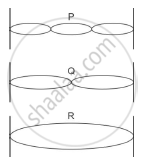
(i) Which vibration will produce a louder sound and why?
(ii) The sound of which string will have maximum shrillness?
(iii) State the ratio of wavelengths of P and R.
How does the medium affect the amplitude of free/natural vibrations of a body?
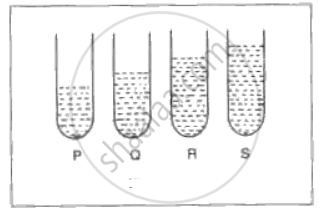
In fig. , P, Q, R and S represent test tubes each of height 20 cm which are filled with water upto heights of 10 cm, 14 cm, 16 cm and 18 cm respectively. If a vibrating tuning fork is placed over the mouth of test tube Q, a loud sound is heard.
(i) Describe the observations with the tubes P, R and S.
(ii) Give the reason for your observation in each case.
(iii) State the principle illustrated by the above experiment.
What do you mean by resonance? When does resonance occur?
A string stretched between its ends is made to vibrate by placing the stem of a vibrating tuning fork at its one end. State three ways how you will increase the frequency of note produced by the string.
Explain Why are stringed musical instruments provided with large sound boxes?
When the stem of vibrating tuning fork is pressed on a table, the tabletop starts vibrating. These vibrations are definitely an example of ______.
