Advertisements
Advertisements
Question
Explain ‘mirage’ as an illustration of refraction.
Advertisements
Solution
- On a hot, clear, sunny day, along a level road, there appears a pond of water ahead of the road. However, if we physically reach the spot, there is nothing but the dry road, and the water pond again appears some distance ahead. This illusion is called a mirage.
- Mirages result from the refraction of light through a non-uniform medium.
- On a hot day the air in contact with the road is hottest, and as we go up, it gets gradually cooler. The refractive index of air thus decreases with height. Hot air tends to be less optically dense than cooler air, which results in a non-uniform medium.
- Light travels in a straight line through a uniform medium but refracts when travelling through a non-uniform medium.
- Thus, the ray of light coming from the top of an object gets refracted while travelling downwards into less optically dense air and becomes more and more horizontal, as shown in the figure.

- As it almost touches the road, it bends (refracts) upward. Then onwards, upward bending continues due to denser air.
- As a result, for an observer, it appears to be coming from below, thereby giving an illusion of reflection from an (imaginary) water surface.
APPEARS IN
RELATED QUESTIONS
State the conditions required for total internal reflection of light to take place
State two conditions necessary for total internal reflection to occur.
Write the relation between the refractive index and critical angle for a given pair of optical media?
Calculate the speed of light in a medium whose critical angle is 30° ?
i) Observe the given figure and answer the following questions.
a) Identify and write the natural process shown in the figure.
b) List the phenomena which are observe in this process.
c) Redraw the diagram and show above phenomena in it.
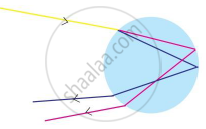
Solve the previous problem if the paperweight is inverted at its place so that the spherical surface touches the paper.
Define critical angle for a given medium.
Express the refractive index μ of a medium in terms of the angle of incidence i in air and the angle of refraction r in a denser medium.
State two advantages of using a right-angle prism as a reflector, rather than a plane mirror.
State one factor on which a critical angle for a given pair of media depends. The critical angle for the glass-air interface is 45° for the yellow light. Will it be equal to, less than or greater than 45° for (i) red light, (ii) blue light?
Name the factors affecting the critical angle for the pair of media.
How is the critical angle of a material related to its refractive index?
Choose the correct option.
Select the WRONG statement.
Answer the following question.
Define the critical angle of incidence and obtain an expression for it.
For a ray of light, the critical angle is minimum when it travels from ______.
Optical fibre communication uses the principle of ______.
The twinkling effect of star light is due to ______.
A bundle of glass threads, each of which is capable of transmitting messages using light waves is called ______.
The critical angle is defined as the angle of incidence at which the total internal reflection starts to occur.
What are the conditions to achieve total internal reflection?
A rectangular block of glass ABCD has a refractive index 1.6. A pin is placed midway on the face AB (Figure). When observed from the face AD, the pin shall ______.
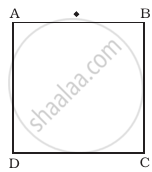
- appear to be near A.
- appear to be near D.
- appear to be at the centre of AD.
- not be seen at all.
A jar of height h is filled with a transparent liquid of refractive index µ (Figure). At the centre of the jar on the bottom surface is a dot. Find the minimum diameter of a disc, such that when placed on the top surface symmetrically about the centre, the dot is invisible.
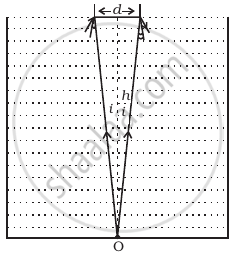
State the condition under which total internal reflection occurs. Give the mathematical expression for total internal reflection.
A ray of light passes through a prism of refractive index `sqrt2` as shown in the figure. Find:
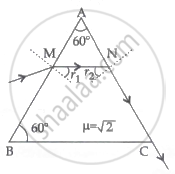
- The angle of incidence (∠r2) at face AC.
- The angle of minimum deviation for this prism.
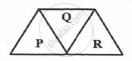
A given ray of light suffers minimum deviation in an equilateral prism P. Additional prism Q and R of identical shape and of the same material as P are now added as shown in the figure. The ray will now suffer ______.
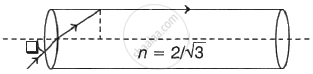
Find the value of θ in the given figure.
The diagram below shows a fish in the tank and its image seen on the surface of the water.
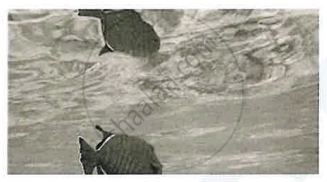
Name the phenomenon responsible for the formation of this image.
