Advertisements
Advertisements
Question
Answer the following question.
Describe the roles of heat, primers, and the bacterium Thermus aquaticus in the process of PCR.
Advertisements
Solution
Role of Heat: It helps in the denaturation process in PCR. The ds DNA is heated in this process at a very high temperature (95ºC) so that both the strands separates.
Role of primers: Primers are chemically synthesised small oligonucleotides of about 10-18 nucleotides that are complementary to a region of template DNA and helps in the extension of the new chain.
Role of Bacterium Thermus aquaticus: From this bacterium, a thermostable Taq DNA polymerase is isolated which can tolerate high temperatures and forms a new strand.
APPEARS IN
RELATED QUESTIONS
ELISA is mainly used for ____________.
Explain how ADA deficiency can be corrected?
Which of the following is a neuropeptide hormone?
ELISA is based on:
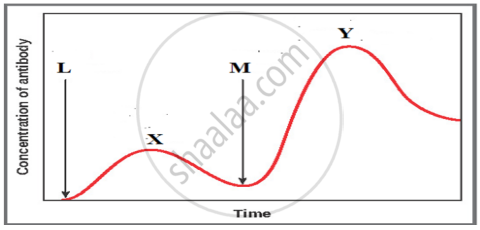
The graph given below indicates the administration of the first (L) and second dose (M) of a vaccine. The corresponding response of the body is indicated by X, and Y. Interpret the graph and explain the reason for such a response shown by the body.
Give a reason for the following:
Streptokinase is administered to the patients having myocardial infarction.
The diagram given below represents the schematic structure of proinsulin, which undergoes certain modifications before it becomes a fully functional insulin.
Study the diagram carefully and answer the questions that follow:

- State the change the proinsulin undergoes to become fully functional.
- Name the modern scientific technique used for the production of human insulin.
- How are the two polypeptide chains of the fully functional insulin held together?
Choose the INCORRECT statement.
Severe Combined Immunodeficiency Disease (SCID) caused by adenosine deaminase (ADA) deficiency arises due to which pathological mechanism?
Which molecular diagnostic tool relies on the hybridisation of labelled single-stranded DNA to detect specific complementary sequences or mutant alleles?
