Advertisements
Advertisements
Question
Answer the following question:
Describe the formation of recombinant DNA by the action of EcoRI.
Advertisements
Solution
Restriction endonuclease enzyme EcoRl is used in molecular biology to cut the foreign DNA and vector DNA to form overhangs (called sticky ends). These sticky ends then form hydrogen bonds with their complementary counterparts. The segments with the help of DNA ligases are joined to produce recombinant DNA.

RELATED QUESTIONS
Describe briefly the following:
Downstream processing
Explain briefly:
PCR
______ plays an important role in blood clotting.
Gene Amplification using primers can be done by ______.
Significance of 'heat shock' method in bacterial transformation is to facilitate ______.
Read the following paragraph and answer the questions that follow:
| Biotechnology revolves around the "gene of interest", with an objective to open various avenues for human welfare in health, medicine, pharma, agriculture etc. using different techniques, tools and processes. One of the breakthroughs of biotechnology in medicine is the gene therapy. |
- Name the human disease for which the gene therapy was used for the first time.
- Explain the steps of gene therapy carried to cure the disease using the lymphocytes of the patient. Why is this therapy not a permanent cure of the disease?
- Write the possible permanent cure of the disease by the gene therapy that is in progress.
State the advantage of using Thermostable DNA polymerase.
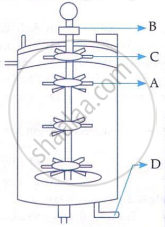
Identify the part of a bio-reactor which is used as a foam braker from the given figure.
In agarose gel electrophoresis, why do DNA fragments move toward the positive electrode?
Which enzyme is responsible for joining the desired gene to a carrier vector DNA to form recombinant DNA?
