Advertisements
Advertisements
Question
A ladder 13 m long leans against a wall. The foot of the ladder is pulled along the ground away from the wall, at the rate of 1.5 m/sec. How fast is the angle θ between the ladder and the ground is changing when the foot of the ladder is 12 m away from the wall.
Advertisements
Solution
Let the bottom of the ladder be at a distance of x m from the wall and its top be at a height of y m from the ground.
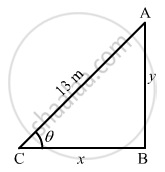
Then,
\[\tan \theta = \frac{y}{x} \text { and } \]
\[ x^2 + y^2 = \left( 13 \right)^2 \]
\[ \Rightarrow x^2 \left( 1 + \tan^2 \theta \right) = 169\]
\[ \Rightarrow \sec^2 \theta = \frac{169}{x^2}\]
\[ \Rightarrow 2 \sec^2 \theta \tan \theta\frac{d\theta}{dt} = 169 \left( \frac{- 2}{x^3} \right)\frac{dx}{dt}\]
\[ \Rightarrow \frac{d\theta}{dt} = \frac{- 338 \times 1 . 5}{\left( 12 \right)^3 2 \sec^2 \theta \tan \theta} . . . \left( 1 \right)\]
\[\text { When } x = 12, y = \sqrt{169 - 144} = 5 m \]
\[So, \]
\[\sec \theta = \frac{13}{12} \text { and } \tan \theta = \frac{12}{5}\]
\[\text { From eq } . \left( 1 \right), \text { we get }\]
\[\frac{d\theta}{dt} = \frac{- 338 \times 1 . 5}{\left( 12 \right)^3 \times 2 \times \left( \frac{13}{12} \right)^2 \times \frac{5}{12}} = \frac{- 338 \times 1 . 5}{10 \times 169} = - 0 . 3 \text { rad }/\text { sec }\]
APPEARS IN
RELATED QUESTIONS
The Volume of cube is increasing at the rate of 9 cm 3/s. How fast is its surfacee area increasing when the length of an edge is 10 cm?
An edge of a variable cube is increasing at the rate of 3 cm/s. How fast is the volume of the cube increasing when the edge is 10 cm long?
A ladder 5 m long is leaning against a wall. The bottom of the ladder is pulled along the ground, away from the wall, at the rate of 2 cm/s. How fast is its height on the wall decreasing when the foot of the ladder is 4 m away from the wall?
The volume of a sphere is increasing at the rate of 3 cubic centimeter per second. Find the rate of increase of its surface area, when the radius is 2 cm
The total revenue received from the sale of x units of a product is given by R (x) = 13x2 + 26x + 15. Find the marginal revenue when x = 7 ?
An edge of a variable cube is increasing at the rate of 3 cm per second. How fast is the volume of the cube increasing when the edge is 10 cm long?
The side of a square is increasing at the rate of 0.2 cm/sec. Find the rate of increase of the perimeter of the square.
The radius of a circle is increasing at the rate of 0.7 cm/sec. What is the rate of increase of its circumference?
The radius of a spherical soap bubble is increasing at the rate of 0.2 cm/sec. Find the rate of increase of its surface area, when the radius is 7 cm.
A particle moves along the curve y = x2 + 2x. At what point(s) on the curve are the x and y coordinates of the particle changing at the same rate?
The top of a ladder 6 metres long is resting against a vertical wall on a level pavement, when the ladder begins to slide outwards. At the moment when the foot of the ladder is 4 metres from the wall, it is sliding away from the wall at the rate of 0.5 m/sec. How fast is the top-sliding downwards at this instance?
How far is the foot from the wall when it and the top are moving at the same rate?
A man 2 metres high walks at a uniform speed of 6 km/h away from a lamp-post 6 metres high. Find the rate at which the length of his shadow increases ?
The surface area of a spherical bubble is increasing at the rate of 2 cm2/s. When the radius of the bubble is 6 cm, at what rate is the volume of the bubble increasing?
A kite is 120 m high and 130 m of string is out. If the kite is moving away horizontally at the rate of 52 m/sec, find the rate at which the string is being paid out.
Find the point on the curve y2 = 8x for which the abscissa and ordinate change at the same rate ?
The length x of a rectangle is decreasing at the rate of 5 cm/minute and the width y is increasing at the rate of 4 cm/minute. When x = 8 cm and y = 6 cm, find the rates of change of the perimeter.
The length x of a rectangle is decreasing at the rate of 5 cm/minute and the width y is increasing at the rate of 4 cm/minute. When x = 8 cm and y = 6 cm, find the rates of change of the area of the rectangle.
The sides of an equilateral triangle are increasing at the rate of 2 cm/sec. How far is the area increasing when the side is 10 cms?
The volume of a sphere is increasing at 3 cm3/sec. The rate at which the radius increases when radius is 2 cm, is
The distance moved by a particle travelling in straight line in t seconds is given by s = 45t + 11t2 − t3. The time taken by the particle to come to rest is
The volume of a sphere is increasing at the rate of 4π cm3/sec. The rate of increase of the radius when the volume is 288 π cm3, is
If the rate of change of area of a circle is equal to the rate of change of its diameter, then its radius is equal to
The equation of motion of a particle is s = 2t2 + sin 2t, where s is in metres and t is in seconds. The velocity of the particle when its acceleration is 2 m/sec2, is
The diameter of a circle is increasing at the rate of 1 cm/sec. When its radius is π, the rate of increase of its area is
In a sphere the rate of change of volume is
In a sphere the rate of change of surface area is
The rate of change of volume of a sphere with respect to its surface area, when the radius is 2 cm, is ______.
A spherical ball of salt is dissolving in water in such a manner that the rate of decrease of the volume at any instant is proportional to the surface. Prove that the radius is decreasing at a constant rate
The radius of a cylinder is increasing at the rate of 3 m/s and its height is decreasing at the rate of 4 m/s. The rate of change of volume when the radius is 4 m and height is 6 m, is ____________.
The rate of change of area of a circle with respect to its radius r at r = 6 cm is ____________.
If the rate of change of volume of a sphere is equal to the rate of change of its radius then the surface area of a sphere is ____________.
Let y = f(x) be a function. If the change in one quantity 'y’ varies with another quantity x, then which of the following denote the rate of change of y with respect to x.
A man 1.6 m tall walks at the rate of 0.3 m/sec away from a street light that is 4 m above the ground. At what rate is the tip of his shadow moving? At what rate is his shadow lengthening?
A particle moves along the curve 3y = ax3 + 1 such that at a point with x-coordinate 1, y-coordinate is changing twice as fast at x-coordinate. Find the value of a.
If equal sides of an isosceles triangle with fixed base 10 cm are increasing at the rate of 4 cm/sec, how fast is the area of triangle increasing at an instant when all sides become equal?
For \[A=\pi r^2\], what is the rate of change of area with respect to radius when \[r=5\] cm?
Which procedure is used in related rates?
