Advertisements
Advertisements
प्रश्न
A ladder 13 m long leans against a wall. The foot of the ladder is pulled along the ground away from the wall, at the rate of 1.5 m/sec. How fast is the angle θ between the ladder and the ground is changing when the foot of the ladder is 12 m away from the wall.
Advertisements
उत्तर
Let the bottom of the ladder be at a distance of x m from the wall and its top be at a height of y m from the ground.
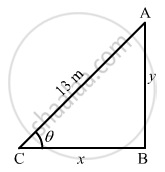
Then,
\[\tan \theta = \frac{y}{x} \text { and } \]
\[ x^2 + y^2 = \left( 13 \right)^2 \]
\[ \Rightarrow x^2 \left( 1 + \tan^2 \theta \right) = 169\]
\[ \Rightarrow \sec^2 \theta = \frac{169}{x^2}\]
\[ \Rightarrow 2 \sec^2 \theta \tan \theta\frac{d\theta}{dt} = 169 \left( \frac{- 2}{x^3} \right)\frac{dx}{dt}\]
\[ \Rightarrow \frac{d\theta}{dt} = \frac{- 338 \times 1 . 5}{\left( 12 \right)^3 2 \sec^2 \theta \tan \theta} . . . \left( 1 \right)\]
\[\text { When } x = 12, y = \sqrt{169 - 144} = 5 m \]
\[So, \]
\[\sec \theta = \frac{13}{12} \text { and } \tan \theta = \frac{12}{5}\]
\[\text { From eq } . \left( 1 \right), \text { we get }\]
\[\frac{d\theta}{dt} = \frac{- 338 \times 1 . 5}{\left( 12 \right)^3 \times 2 \times \left( \frac{13}{12} \right)^2 \times \frac{5}{12}} = \frac{- 338 \times 1 . 5}{10 \times 169} = - 0 . 3 \text { rad }/\text { sec }\]
APPEARS IN
संबंधित प्रश्न
A point source of light is hung 30 feet directly above a straight horizontal path on which a man of 6 feet in height is walking. How fast will the man’s shadow lengthen and how fast will the tip of shadow move when he is walking away from the light at the rate of 100 ft/min.
The rate of growth of bacteria is proportional to the number present. If, initially, there were
1000 bacteria and the number doubles in one hour, find the number of bacteria after 2½
hours.
[Take `sqrt2` = 1.414]
Find the rate of change of the area of a circle with respect to its radius r when r = 3 cm.
An edge of a variable cube is increasing at the rate of 3 cm/s. How fast is the volume of the cube increasing when the edge is 10 cm long?
The radius of a circle is increasing at the rate of 0.7 cm/s. What is the rate of increase of its circumference?
A balloon, which always remains spherical on inflation, is being inflated by pumping in 900 cubic centimetres of gas per second. Find the rate at which the radius of the balloon increases when the radius is 15 cm.
A ladder 5 m long is leaning against a wall. The bottom of the ladder is pulled along the ground, away from the wall, at the rate of 2 cm/s. How fast is its height on the wall decreasing when the foot of the ladder is 4 m away from the wall?
The total revenue in rupees received from the sale of x units of a product is given by R(x) = 13x2 + 26x + 15. Find the marginal revenue when x = 7.
The rate of change of the area of a circle with respect to its radius r at r = 6 cm is ______.
The volume of a sphere is increasing at the rate of 8 cm3/s. Find the rate at which its surface area is increasing when the radius of the sphere is 12 cm.
The total cost C(x) associated with the production of x units of an item is given by C(x) = 0.005x3 – 0.02x2 + 30x + 5000. Find the marginal cost when 3 units are produced, whereby marginal cost we mean the instantaneous rate of change of total cost at any level of output.
Find the rate of change of the total surface area of a cylinder of radius r and height h, when the radius varies?
Find the rate of change of the volume of a cone with respect to the radius of its base ?
A particle moves along the curve y = x3. Find the points on the curve at which the y-coordinate changes three times more rapidly than the x-coordinate.
Find an angle θ which increases twice as fast as its cosine ?
The radius of a cylinder is increasing at the rate 2 cm/sec. and its altitude is decreasing at the rate of 3 cm/sec. Find the rate of change of volume when radius is 3 cm and altitude 5 cm.
The volume of metal in a hollow sphere is constant. If the inner radius is increasing at the rate of 1 cm/sec, find the rate of increase of the outer radius when the radii are 4 cm and 8 cm respectively.
A particle moves along the curve y = (2/3)x3 + 1. Find the points on the curve at which the y-coordinate is changing twice as fast as the x-coordinate ?
The length x of a rectangle is decreasing at the rate of 5 cm/minute and the width y is increasing at the rate of 4 cm/minute. When x = 8 cm and y = 6 cm, find the rates of change of the area of the rectangle.
The radius of a circle is increasing at the rate of 0.5 cm/sec. Find the rate of increase of its circumference ?
The side of an equilateral triangle is increasing at the rate of \[\frac{1}{3}\] cm/sec. Find the rate of increase of its perimeter ?
Side of an equilateral triangle expands at the rate of 2 cm/sec. The rate of increase of its area when each side is 10 cm is
The radius of a sphere is changing at the rate of 0.1 cm/sec. The rate of change of its surface area when the radius is 200 cm is
A cone whose height is always equal to its diameter is increasing in volume at the rate of 40 cm3/sec. At what rate is the radius increasing when its circular base area is 1 m2?
The altitude of a cone is 20 cm and its semi-vertical angle is 30°. If the semi-vertical angle is increasing at the rate of 2° per second, then the radius of the base is increasing at the rate of
A man 2 metres tall walks away from a lamp post 5 metres height at the rate of 4.8 km/hr. The rate of increase of the length of his shadow is
In a sphere the rate of change of volume is
A 13 m long ladder is leaning against a wall, touching the wall at a certain height from the ground level. The bottom of the ladder is pulled away from the wall, along the ground, at the rate of 2 m/s. How fast is the height on the wall decreasing when the foot of the ladder is 5 m away from the wall?
For the curve y = 5x – 2x3, if x increases at the rate of 2 units/sec, then how fast is the slope of curve changing when x = 3?
The volume of a cube increases at a constant rate. Prove that the increase in its surface area varies inversely as the length of the side
x and y are the sides of two squares such that y = x – x2. Find the rate of change of the area of second square with respect to the area of first square.
A particle is moving along the curve x = at2 + bt + c. If ac = b2, then particle would be moving with uniform ____________.
The rate of change of volume of a sphere is equal to the rate of change of the radius than its radius equal to ____________.
A ladder 5 m long is leaning against a wall. The bottom of the ladder is pulled along the ground, away from the wall, at the rate of 2 cm/s. How fast is its height on the wall decreasing when the foot of the ladder is 4 m away from the wall?
A man 1.6 m tall walks at the rate of 0.3 m/sec away from a street light that is 4 m above the ground. At what rate is the tip of his shadow moving? At what rate is his shadow lengthening?
When \(x\) and \(y\) both vary with respect to \(t\), which formula gives the rate of change of \(y\) with respect to \(x\)?
For the Chain Rule for Rates \[\frac{dy}{dx}=\frac{\frac{dy}{dt}}{\frac{dx}{dt}}\], which condition is required?
