Advertisements
Chapters
![Selina solutions for Concise Physics [English] Class 9 ICSE chapter 4 - Pressure in Fluids and Atmospheric Pressure - Shaalaa.com](/images/concise-physics-english-class-9-icse_6:8a0c4572dea049a29e575abe2d9ca662.jpg "Selina solutions for Concise Physics [English] Class 9 ICSE chapter 4 - Pressure in Fluids and Atmospheric Pressure")
Advertisements
Solutions for Chapter 4: Pressure in Fluids and Atmospheric Pressure
Below listed, you can find solutions for Chapter 4 of CISCE Selina for Concise Physics [English] Class 9 ICSE.
Selina solutions for Concise Physics [English] Class 9 ICSE 4 Pressure in Fluids and Atmospheric Pressure Exercise 4 (A) [Pages 92 - 93]
Define the term thrust. State its S.I. unit.
What is meant by pressure? State its S.I. unit.
What physical quantity is measured in bar?
How is the unit bar related to the S.I. unit pascal?
Define one pascal (Pa), the S.I. unit of pressure.
State whether thrust is a scalar or vector?
State whether pressure is a scalar or vector?
Differentiate between thrust and pressure.
How does the pressure exerted by thrust depend on the area of surface on which it acts? Explain with a suitable example.
Why is the tip of an allpin made sharp?
Explain the following statement:
It is easier to cut with a sharp knife than with a blunt one.
Explain the following statement:
Sleepers are laid below the rails.
What is a fluid?
What do you mean by the term fluid pressure?
How does the pressure exerted by a solid and fluid differ?
Describe a simple experiment to demonstrate that a liquid enclosed in a vessel exerts pressure in all directions.
State three factors on which the pressure at a point in a liquid depends.
Write an expression for the pressure at a point inside a liquid. Explain the meaning of the symbols used.
Deduce an expression for the pressure at depth inside a liquid.
How does the pressure at a certain depth in sea water differ from that at the same depth in river water? Explain your answer.
Pressure at the free surface of a water lake is P1, while at a point at depth h below its free surface is P2. (a) How are P1 and P2 related? (b)Which is more P1 or P2?
Explain why a gas bubble released at the bottom of a lake grows in size as it rises to the surface of the lake.
A dam has broader walls at the bottom than at the top. Explain.
Why do sea divers need special protective suit?
State the laws of liquid pressure.
A tall vertical cylinder filled with water is kept on a horizontal table top. Two small holes A and B are made on the wall of the cylinder, A near the middle and B just Below the free surface of water. State and explain your observation.
How does the liquid pressure on a diver change if:
the diver moves to the greater depth
How does the liquid pressure on a diver change if :
The diver moves horizontally?
State Pascal's law of transmission of pressure.
Name two applications of Pascal's law.
Explain the principle of a hydraulic machine. Name two devices which work on this principle.
Name and state the principle on which a hydraulic press works. Write one use of hydraulic press.
The diagram below in Fig. 4.12 shows a device which makes the use of the principle of transmission of pressure.
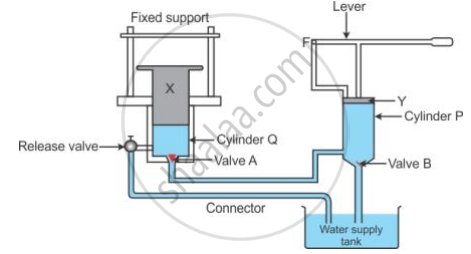
- Name the parts labelled by the letters X and Y.
- Describe what happens to valves A and B and to the quantity of water in the two cylinders when the lever arm is moved down.
- Give reasons for what happens to valves A and B in part (ii).
- What happens when the release valve is opened?
- What happens to valve B in cylinder P when the lever arm is moved up?
- Give a reason for your answer in part (v).
- State one use of the above device.
Draw a simple diagram of a hydraulic jack and explain its working.
Explain the working of a hydraulic brake with a simple labelled diagram.
Complete the following sentence :
Pressure at a depth h in a liquid of density p is ......................
Complete the following sentence :
Pressure is .................... in all directions about a point in a liquid.
Complete the following sentence :
Pressure at all points at the same depth is ....................
Complete the following sentence :
Pressure at a point inside the liquid is ...................... To its depth.
Complete the following sentence :
Pressure of a liquid at a given depth is .................. To the density of the liquid.
Selina solutions for Concise Physics [English] Class 9 ICSE 4 Pressure in Fluids and Atmospheric Pressure Exercise 4 (A) [Page 93]
The S.I. unit of pressure is :
N cm-2
Pa
N
N m2
The pressure inside a liquid of density p at a depth h is :
h ρ g
`h/(ρg)`
`(hρ)/g`
`hρ`
The pressure P1 at a certain depth in river water and P2 at the same depth in sea water are related as :
P1 > P2
P1= P2
P1 < P2
P1 - P2 = atmospheric pressure
The pressure P1 at the top of a dam and P2 at a depth h form the top inside water (density p) are related as :
P1 > P2
P1 = P2
P1 - P2 = h ρ g
P2 - P1 = h ρ g
Selina solutions for Concise Physics [English] Class 9 ICSE 4 Pressure in Fluids and Atmospheric Pressure Exercise 4 (A) [Pages 93 - 94]
A hammer exerts a force of 1.5 N on each of the two nails A and B. The area of cross section of tip of nail A is 2 mm2 while that of nail B is 6 mm2. Calculate pressure on each nail in pascal.
A block of iron of mass 7.5 kg and of dimensions 12 cm × 8 cm × 10 cm is kept on a table top on its base of side 12 cm × 8 cm.
Calculate:
- Thrust and
- Pressure exerted on the table top
Take 1 kgf = 10 N.
A vessel contains water up to a height of 1.5 m. Taking the density of water 103 kg m-3, acceleration due to gravity 9.8 m s-2 and area of base of vessel 100 cm2, calculate: (a) the pressure and (b) the thrust at the base of vessel.
The area of base of a cylindrical vessel is 300 cm2. Water (density= 1000 kg m-3) is poured into it up to a depth of 6 cm. Calculate : (a) the pressure and (b) the thrust of water on the base. (g = 10m s-2.
- Calculate the height of a water column which will exert on its base the same pressure as the 70 cm column of mercury. Density of mercury is 13.6 g cm-3.
- Will the height of the water column in part (a) change if the cross-section of the water column is made wider?
The pressure of water on the ground floor is 40,000 Pa and on the first floor is 10,000 Pa. Find the height of the first floor. (Take : density of water = 1000 kg m-3, g = 10 m s-2)
A simple U tube contains mercury to the same level in both of its arms. If water is poured to a height of 13.6 cm in one arm, how much will be the rise in mercury level in the other arm?
Given : density of mercury = 13.6 x 10³ kg m-3 and density of water = 103 kg m-3.
In a hydraulic machine, a force of 2 N is applied on the piston of area of cross section 10 cm2. What force is obtained on its piston of area of cross section 100 cm2 ?
What should be the ratio of area of cross section of the master cylinder and wheel cylinder of a hydraulic brake so that a force of 15 N can be obtained at each of its brake shoe by exerting a force of 0.5 N on the pedal ?
The areas of pistons in a hydraulic machine are 5 cm2 and 625 cm2. What force on the smaller piston will support a load of 1250 N on the larger piston? State any assumption which you make in your calculation.
(i) The diameter of neck and bottom of a bottle are 2 cm and 10 cm, respectively. The bottle is completely filled with oil. If the cork in the neck is pressed in with a force of 1.2 kgf, what force is exerted on the bottom of the bottle?
(ii) Name the law/principle you have used to find the force in part (a).
A force of 50 kgf is applied to the smaller piston of a hydraulic machine. Neglecting friction, find the force exerted on the large piston, if the diameters of the pistons are 5 cm and 25 cm respectively.
Two cylindrical vessels fitted with pistons A and B of area of cross-section 8 cm2 and 320 cm2 respectively are joined at their bottom by a tube and they are completely filled with water. When a mass of 4 kg is placed on piston A, Find:
- the pressure on piston A,
- the pressure on piston B, and
- the thrust on piston B.
What force is applied on a piston of area of cross section 2 cm2 to obtain a force 150 N on the piston of area of cross section 12 cm2 in a hydraulic machine?
Selina solutions for Concise Physics [English] Class 9 ICSE 4 Pressure in Fluids and Atmospheric Pressure Exercise 4 (B) [Pages 101 - 102]
What do you understand by atmospheric pressure?
Write the numerical value of the atmospheric pressure on the surface of earth in pascal.
What physical quantity is measured in torr? How is it related to the S.I. unit of the quantity?
Name the physical quantity which is expressed in the unit 'atm'. State its value in pascal.
We do not feel uneasy even under enormous pressure of the atmosphere above as well as around us. Give a reason.
Describe an experiment to demonstrate that air exerts pressure.
Explain the following :
A balloon collapses when air is removed from it.
Explain the following :
Water does not run out of a dropper unless its rubber bulb is pressed .
Explain the following :
Two holes are made in a completely filled sealed tin can to take out oil from it .
Why does the liquid rise in a syringe when its piston is pulled up?
How is water drawn up from a well by a water pump?
A partially inflated balloon is placed inside a bell jar connected to a vacuum pump. On creating vacuum inside the bell jar, balloon gets more inflated. How does the pressure change: increase, decrease or remains same, inside the (a) bell jar, (b) balloon?
What is the purpose of a barometer?
What is a barometer?
How is a simple barometer constructed?
Explain how is the height of mercury column in tube of a simple barometer, a measure of the atmospheric pressure.
Illustrate with the help of a labelled diagram of a simple barometer that the atmospheric pressure at a place is 76 cm of Hg.
Why is the barometric height used as unit to express the atmospheric pressure?
What is meant by the statement 'the atmospheric pressure at a place is 76 cm of Hg'? State its value in Pa.
How will you show that there is vacuum above the surface of mercury in a barometer? What name is given to this vacuum?
How is the barometric height of a simple barometer affected if Its tube is pushed down into the trough of mercury?
How is the barometric height of a simple barometer affected if Its tube is slightly tilted from vertical?
How is the barometric height of a simple barometer affected if A drop of liquid is inserted inside the tube?
State two uses of a barometer.
Give two reasons for use of mercury as a barometric liquid.
Give two reasons why water is not a suitable barometric liquid.
Mention two demerits of a simple barometer and state how they are removed in a Fortin barometer .
Draw a simple labelled diagram of a Fortin barometer and state how it is used to measure the atmospheric pressure.
What is an aneroid barometer? Draw a neat and labelled diagram to explain its construction and working.
State two advantages of an aneroid barometer over a simple barometer.
How is the reading of a barometer affected when it is taken to (i) a mine, and (ii) a hill?
How does the atmospheric pressure change with altitude? Draw an approximate graph to show this variation.
State two factors which affect the atmospheric pressure as we go up.
Why does a fountain pen leak at high altitude?
Why does nose start bleeding on high mountains?
What is an altimeter? State its principle. How is its scale calibrated?
What do the following indicate in a barometer regarding weather : gradual fall in the mercury level
What do the following indicate in a barometer regarding weather : sudden fall in the mercury level
What do the following indicate in a barometer regarding weather : Gradual rise in the mercury level?
Selina solutions for Concise Physics [English] Class 9 ICSE 4 Pressure in Fluids and Atmospheric Pressure Exercise 4 (B) [Page 102]
The unit torr is related to the barometric height as :
1 torr = l cm of Hg
1 torr = 0.76 m of Hg
1 torr = 1 mm of Hg
1 torr = 1m of Hg
The normal atmospheric pressure is :
76 m of Hg
76 cm of Hg
76 Pa
76 N m-2
The atmospheric pressure at earth's surface is P1 and inside mine is P2. They are related as :
P l =P2
P l > P2
P l < P2
P2 = 0
Selina solutions for Concise Physics [English] Class 9 ICSE 4 Pressure in Fluids and Atmospheric Pressure Exercise 4 (B) [Page 102]
Convert 1 mm of Hg into pascal. Take density of Hg = 13.6 x 10³ kg m-3 and g = 9.8 m s-2 .
At a given place, a mercury barometer records a pressure of 0.70 m of Hg. What would be the height of water column if mercury in barometer is replaced by water? Take density of mercury to be = 13.6 × 10³ kg m-3.
At sea level, the atmospheric pressure is 76 cm of Hg. If air pressure falls by 10 mm of Hg per 120m of ascent, what is the height of a hill where the barometer reads 70 cm Hg. State the assumption made by you.
At sea level, the atmospheric pressure is 1.04 x 10⁵ Pa. Assuming g = 10 m s-2 and density of air to be uniform and equal to 1.3 kg m-3, find the height of the atmosphere.
Assuming the density of air to be 1.295 kg m-3, find the fall in barometric height in mm of Hg at a height of 107 m above the sea level. Take density of mercury = 13.6 × 10³ kg m-3.
Solutions for 4: Pressure in Fluids and Atmospheric Pressure
Selina solutions for Concise Physics [English] Class 9 ICSE chapter 4 - Pressure in Fluids and Atmospheric Pressure
Shaalaa.com has the CISCE Mathematics Concise Physics [English] Class 9 ICSE CISCE solutions in a manner that help students grasp basic concepts better and faster. The detailed, step-by-step solutions will help you understand the concepts better and clarify any confusion. Selina solutions for Mathematics Concise Physics [English] Class 9 ICSE CISCE 4 (Pressure in Fluids and Atmospheric Pressure) include all questions with answers and detailed explanations. This will clear students' doubts about questions and improve their application skills while preparing for board exams.
Further, we at Shaalaa.com provide such solutions so students can prepare for written exams. Selina textbook solutions can be a core help for self-study and provide excellent self-help guidance for students.
Concepts covered in Concise Physics [English] Class 9 ICSE chapter 4 Pressure in Fluids and Atmospheric Pressure are Thrust and Pressure, Variation of Pressure with Depth in a Fluid, Pascal’s Law, Law of Liquid Pressure, Consequences of Liquid Pressure, Pressure Exerted by a Liquid Column, Application of Pascal’s Law, Factors Affecting Pressure, Pressure of liquid, Hydraulic Machines: Hydraulic Press (Or Bramah Press), Atmospheric Pressure, Consequences of Atmospheric Pressure, Measurement of Atmospheric Pressure, Mercury Barometer (Simple Barometer), Fortin’s Barometer, Aneroid Barometer, Variation of Atmospheric Pressure with Altitude, Weather Forecast by the Use of Arometer, Altimeter, Introduction of Fluid, Buoyancy Force (Upthrust Force), Principle of Floatation (Laws of Flotation), Archimedes Principle, Characteristic Properties of Upthrust, Reason for Upthrust, Upthrust is Equal to the Weight of Displaced Liquid (Mathematical Proof), Solid Bodies with density (ρ) greater than density of liquid (ρL) sink while with density (ρ) less than density of liquid (ρL) Float, Density and It’s Unit, Relative Density and Its Unit, Relationship Between Density and Relative Density, Determination of Relative Density of a Solid Substance by Archimedes’ Principle, Determination of Relative Density of a Liquid by Archimedes’ Principle, Relation Between Volume of Submerged Part of a Floating Body, the Densities of Liquid and the Body, Application of the Principle of Floatation.
Using Selina Concise Physics [English] Class 9 ICSE solutions Pressure in Fluids and Atmospheric Pressure exercise by students is an easy way to prepare for the exams, as they involve solutions arranged chapter-wise and also page-wise. The questions involved in Selina Solutions are essential questions that can be asked in the final exam. Maximum CISCE Concise Physics [English] Class 9 ICSE students prefer Selina Textbook Solutions to score more in exams.
Get the free view of Chapter 4, Pressure in Fluids and Atmospheric Pressure Concise Physics [English] Class 9 ICSE additional questions for Mathematics Concise Physics [English] Class 9 ICSE CISCE, and you can use Shaalaa.com to keep it handy for your exam preparation.
