Advertisements
Advertisements
प्रश्न
Explain why a gas bubble released at the bottom of a lake grows in size as it rises to the surface of the lake.
Advertisements
उत्तर
The reason is that when the bubble is at the bottom of the lake, total pressure exerted on it is the atmospheric pressure plus the pressure due to water column. As the gas bubble rises, due to decrease in depth the pressure due to water column decreases. By Boyle's law, PV = constant, so the volume of bubble increases due to decrease in pressure, i.e., the bubble grows in size.
APPEARS IN
संबंधित प्रश्न
What do you mean by buoyancy?
A body X sinks in water, but a body Y floats on water. The density of the body X is ......... than the density of body Y.
If a fresh egg is put into a beaker filled with water, it sinks. On dissolving a lot of salt in the water, the egg begins to rise and then floats. Why ?
Define the term relative density of a substance.
What is the unit of relative density?
A cork piece floats on water surface while an iron nail sinks in it. Explain the reason.
Which of the following will sink or float on water? (Density of water = 1 g Cm-3) body B having density 2520 kg m-3
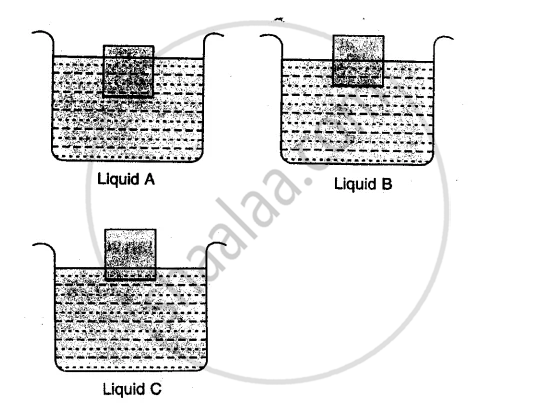
The diagram given below show a body floating in three different liquids. A, B and C at different levels.
(a) In which liquid does the body experience the greatest buoyant force?
(b) Which liquid has the least density?
(c) Which liquid has the highest density?
A beaker contains a liquid of density ‘ρ’ up to height ‘h’ such that ‘PA’ is atmospheric pressure and ‘g’ is the acceleration due to gravity. Answer the following questions:
- What is the pressure on the free surface of the liquid?
- What is the pressure on the base of the beaker?
- What is the lateral pressure at the base on the inner walls of the beaker?
State whether true or false. If false, correct the statement.
The weight of fluid displaced determines the buoyant force on an object.
