Advertisements
Advertisements
प्रश्न
How does the pressure exerted by a solid and fluid differ?
Advertisements
उत्तर
A solid exerts pressure only on the surface on which it is placed, i.e. at its bottom, but a fluid exerts pressure at all points in all directions.
संबंधित प्रश्न
In what direction does the buoyant force on an object immersed in a liquid act?
In which direction does the buoyant force on an object due to a liquid act ?
How does the density of a body and that of a liquid determine whether the body will float or sink into that liquid?
What is the law of floatation?
What is meant by pressure? State its S.I. unit.
Complete the following sentence :
Pressure at all points at the same depth is ....................
A simple U tube contains mercury to the same level in both of its arms. If water is poured to a height of 13.6 cm in one arm, how much will be the rise in mercury level in the other arm?
Given : density of mercury = 13.6 x 10³ kg m-3 and density of water = 103 kg m-3.
A body experiences an upthrust F1 in river water and F2 in sea water when dipped up to the same level. Which is more, F1 or F2? Give reason.
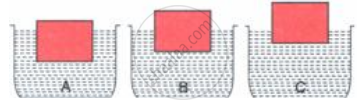
Figure shows the same block of wood floating in three different liquids A, B and C of densities ρ1, ρ2 and ρ3 respectively. Which of the liquid has the highest density? Give a reason for your answer.
The base of the cylindrical vessel measures 300 cm2. Water is poured into it up to a depth of 6 cm. Calculate the pressure of water on the base in the vessel.
