Advertisements
Advertisements
प्रश्न
Two cylindrical vessels fitted with pistons A and B of area of cross-section 8 cm2 and 320 cm2 respectively are joined at their bottom by a tube and they are completely filled with water. When a mass of 4 kg is placed on piston A, Find:
- the pressure on piston A,
- the pressure on piston B, and
- the thrust on piston B.
Advertisements
उत्तर
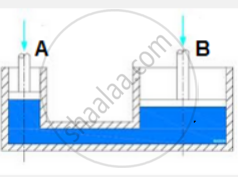
Given that the force applied to the smaller piston A is 4 kg
Area of cross-section of piston A = 8 cm²
Area of cross-section of piston B = 320 cm²
(i) Pressure acting on piston A in the downward direction = `"Thrust"/"Area"`
= `(4 "kg")/(8 "cm"^2)`
∴ Pressure acting on piston A = 0.5 kg cm-2
(ii) According to Pascal's Law
Pressure acting on piston B = Pressure acting on Piston A = 0.5 kg cm-2
(iii) Thrust acting on piston B in the upward direction
= Pressure × Area of B
= 4 kg × `(320 "cm"^2)/(8 "cm"^2)`
∴ Thrust acting on piston B in the upward direction = 160 kgf.
संबंधित प्रश्न
Fill in the blank with suitable word :
It is the................. force which makes objects appear lighter in water.
Deduce an expression for the pressure at depth inside a liquid.
Explain why a gas bubble released at the bottom of a lake grows in size as it rises to the surface of the lake.
A tall vertical cylinder filled with water is kept on a horizontal table top. Two small holes A and B are made on the wall of the cylinder, A near the middle and B just Below the free surface of water. State and explain your observation.
What do you understand by the term upthrust of a fluid? Describe an experiment to show its existence.
A metal solid cylinder tied to a thread is hanging from the hook of a spring balance. The cylinder is gradually immersed into the water contained in a jar. What changes do you expect in the readings of the spring balance? Explain your answer.
Pressure in a water pipe on the ground floor of a building is 100,000 Pa. Calculate the pressure in the water pipe on the first floor at a height of 3 m. [Density of water = 1000 kgm−3 ; g = 10 ms−2]
Is thrust a scalar or vector quantity?
In a fluid, buoyant force exists because the pressure at the ______ of an object is greater than the pressure at the top.
Assertion (A): The buoyant force on a submerged rigid object can be considered to be acting at the center of mass of the object.
Reason (R): In rigid body, force distributed uniformly through its volume can be considered to be acting at the centre of mass of the body.
