Advertisements
Advertisements
प्रश्न
Two cylindrical vessels fitted with pistons A and B of area of cross-section 8 cm2 and 320 cm2 respectively are joined at their bottom by a tube and they are completely filled with water. When a mass of 4 kg is placed on piston A, Find:
- the pressure on piston A,
- the pressure on piston B, and
- the thrust on piston B.
Advertisements
उत्तर
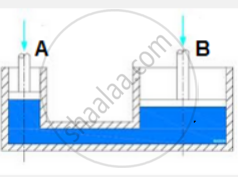
Given that the force applied to the smaller piston A is 4 kg
Area of cross-section of piston A = 8 cm²
Area of cross-section of piston B = 320 cm²
(i) Pressure acting on piston A in the downward direction = `"Thrust"/"Area"`
= `(4 "kg")/(8 "cm"^2)`
∴ Pressure acting on piston A = 0.5 kg cm-2
(ii) According to Pascal's Law
Pressure acting on piston B = Pressure acting on Piston A = 0.5 kg cm-2
(iii) Thrust acting on piston B in the upward direction
= Pressure × Area of B
= 4 kg × `(320 "cm"^2)/(8 "cm"^2)`
∴ Thrust acting on piston B in the upward direction = 160 kgf.
संबंधित प्रश्न
A body experiences the same buoyant force while floating in water or alcohol.
What happens to the buoyant force as more and more volume of a solid object is immersed in a liquid ? When does the buoyant force become maximum ?
Define buoyant force. Name two factors on which buoyant force depends.
Define the term Density of a substance.
Define the term thrust. State its S.I. unit.
A hammer exerts a force of 1.5 N on each of the two nails A and B. The area of cross section of tip of nail A is 2 mm2 while that of nail B is 6 mm2. Calculate pressure on each nail in pascal.
The S.I. unit of upthrust is :
Complete the following sentence.
Mass = .................... × density
Pressure in a water pipe on the ground floor of a building is 100,000 Pa. Calculate the pressure in the water pipe on the first floor at a height of 3 m. [Density of water = 1000 kgm−3 ; g = 10 ms−2]
Complete the analogy.
Downward force : Weight :: Upward force offered by liquid : ______
