Advertisements
Advertisements
Question
Two cylindrical vessels fitted with pistons A and B of area of cross-section 8 cm2 and 320 cm2 respectively are joined at their bottom by a tube and they are completely filled with water. When a mass of 4 kg is placed on piston A, Find:
- the pressure on piston A,
- the pressure on piston B, and
- the thrust on piston B.
Advertisements
Solution
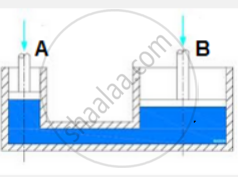
Given that the force applied to the smaller piston A is 4 kg
Area of cross-section of piston A = 8 cm²
Area of cross-section of piston B = 320 cm²
(i) Pressure acting on piston A in the downward direction = `"Thrust"/"Area"`
= `(4 "kg")/(8 "cm"^2)`
∴ Pressure acting on piston A = 0.5 kg cm-2
(ii) According to Pascal's Law
Pressure acting on piston B = Pressure acting on Piston A = 0.5 kg cm-2
(iii) Thrust acting on piston B in the upward direction
= Pressure × Area of B
= 4 kg × `(320 "cm"^2)/(8 "cm"^2)`
∴ Thrust acting on piston B in the upward direction = 160 kgf.
RELATED QUESTIONS
A cork piece floats on water surface while an iron nail sinks in it. Explain the reason.
What is the law of floatation?
Deduce an expression for the pressure at depth inside a liquid.
Pressure at the free surface of a water lake is P1, while at a point at depth h below its free surface is P2. (a) How are P1 and P2 related? (b)Which is more P1 or P2?
A dam has broader walls at the bottom than at the top. Explain.
Why is a force needed to keep a block of wood inside water?
A body will experience minimum upthrust when it is completely immersed in :
Select the correct option:
When an object sinks in a liquid, its:
Salt water provides less buoyant force than freshwater.
