Advertisements
Advertisements
Question
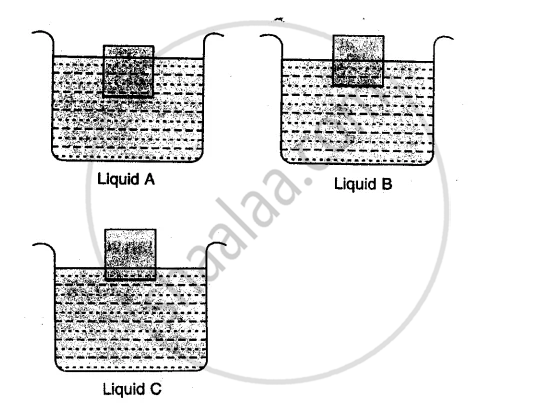
The diagram given below show a body floating in three different liquids. A, B and C at different levels.
(a) In which liquid does the body experience the greatest buoyant force?
(b) Which liquid has the least density?
(c) Which liquid has the highest density?
Advertisements
Solution
a) Buoyant force is same in each case as the wt. of the body is same in each case and Buoyant force is equal to the weight of the liquid displaced by the immersed part of the body which balances the wt. of body.
(b) The liquid A has the least density as body immerses the maximum.
(c) Liquid C has the highest density as the body immerses the least.
APPEARS IN
RELATED QUESTIONS
What is the scientific name of the 'upward force' acting on an object immersed in a liquid?
What is the law of floatation?
State whether thrust is a scalar or vector?
How is the upthrust related to the volume of the body submerged in a liquid?
A small block of wood is completely immersed in (i) water, (ii) glycerine and then released. In each case, What do you observe? Explain the difference in your observation in the two cases.
The mass of a block made of certain material is 13.5 kg and its volume is 15 × 10-3 m3.
(a) Calculate upthrust on the block if it is held fully immersed in water.
(b) Will the block float or sink in water when released? Give a reason for your answer.
(c) What will be the upthrust on block while floating?
Take density of water = 1000 kg m-3.
The blood pressure reading of a patient is recorded 160/100. Express the lower pressure in SI units.
[Take density of mercury as 13.6 × 10³ kgm−3 and the value of ‘g’ as 10 ms−2]
Higher Order Thinking Skill.
How does a fish manage to rise up and move down in water?
In a fluid, buoyant force exists because the pressure at the ______ of an object is greater than the pressure at the top.
If the buoyant force is less, the object will float.
