Advertisements
Advertisements
प्रश्न
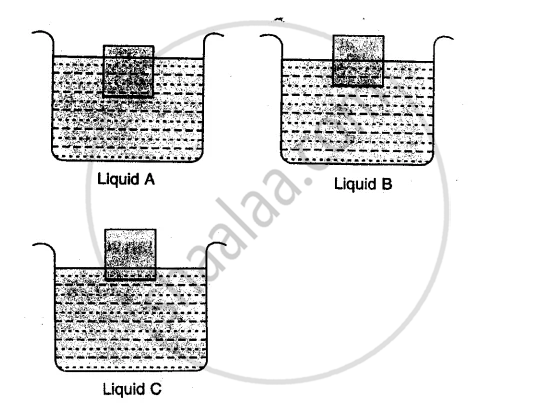
The diagram given below show a body floating in three different liquids. A, B and C at different levels.
(a) In which liquid does the body experience the greatest buoyant force?
(b) Which liquid has the least density?
(c) Which liquid has the highest density?
Advertisements
उत्तर
a) Buoyant force is same in each case as the wt. of the body is same in each case and Buoyant force is equal to the weight of the liquid displaced by the immersed part of the body which balances the wt. of body.
(b) The liquid A has the least density as body immerses the maximum.
(c) Liquid C has the highest density as the body immerses the least.
APPEARS IN
संबंधित प्रश्न
In which direction does the buoyant force on an object due to a liquid act ?
An object of weight 200 N is floating in a liquid. What is the magnitude of buoyant force acting on it ?
The S.I. unit of density is ..........
Explain why an iron needle sinks in water, but a ship made of iron floats on water.
What is meant by pressure? State its S.I. unit.
The area of base of a cylindrical vessel is 300 cm2. Water (density= 1000 kg m-3) is poured into it up to a depth of 6 cm. Calculate : (a) the pressure and (b) the thrust of water on the base. (g = 10m s-2.
A simple U tube contains mercury to the same level in both of its arms. If water is poured to a height of 13.6 cm in one arm, how much will be the rise in mercury level in the other arm?
Given : density of mercury = 13.6 x 10³ kg m-3 and density of water = 103 kg m-3.
Two cylindrical vessels fitted with pistons A and B of area of cross-section 8 cm2 and 320 cm2 respectively are joined at their bottom by a tube and they are completely filled with water. When a mass of 4 kg is placed on piston A, Find:
- the pressure on piston A,
- the pressure on piston B, and
- the thrust on piston B.
A body of mass 3.5 kg displaces 1000 cm3 of water when fully immersed inside it. Calculate:
- the volume of body,
- the upthrust on body and
- the apparent weight of body in water.
Complete the analogy.
Downward force: Weight:: Upward force offered by liquid: _____
