Advertisements
Advertisements
प्रश्न
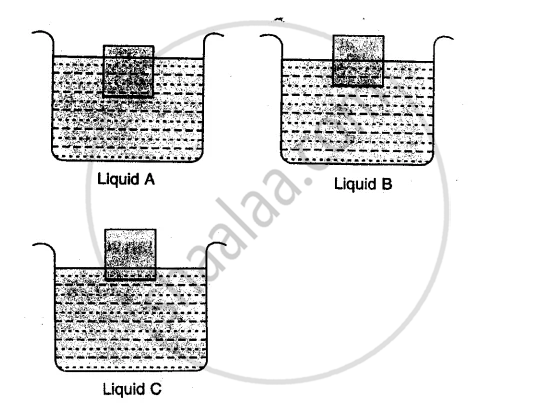
The diagram given below show a body floating in three different liquids. A, B and C at different levels.
(a) In which liquid does the body experience the greatest buoyant force?
(b) Which liquid has the least density?
(c) Which liquid has the highest density?
Advertisements
उत्तर
a) Buoyant force is same in each case as the wt. of the body is same in each case and Buoyant force is equal to the weight of the liquid displaced by the immersed part of the body which balances the wt. of body.
(b) The liquid A has the least density as body immerses the maximum.
(c) Liquid C has the highest density as the body immerses the least.
APPEARS IN
संबंधित प्रश्न
State whether the following statement is true or false :
The buoyant force depends on the nature of object immersed in the liquid
What is meant by the term ‘buoyancy’ ?
Which of the following will sink or float on water? (Density of water = 1 g Cm-3)
(a) body A having density of 500 kg m-3
Which of the following will sink or float on water? (Density of water = 1 g Cm-3) body B having density 2520 kg m-3
How does the pressure exerted by thrust depend on the area of surface on which it acts? Explain with a suitable example.
(i) The diameter of neck and bottom of a bottle are 2 cm and 10 cm, respectively. The bottle is completely filled with oil. If the cork in the neck is pressed in with a force of 1.2 kgf, what force is exerted on the bottom of the bottle?
(ii) Name the law/principle you have used to find the force in part (a).
A body of mass 3.5 kg displaces 1000 cm3 of water when fully immersed inside it. Calculate:
- the volume of body,
- the upthrust on body and
- the apparent weight of body in water.
Complete the following sentence.
Mass = .................... × density
A body is held inside water contained in a vessel by tying it with a thread to the base of the vessel. Name the three forces that keep the body in equilibrium, and state the direction in which each force acts.
Write about buoyant force.
