Advertisements
Advertisements
Question
What is a density bottle? How is it used to find the density of a liquid?
Advertisements
Solution 1
Density bottle is a small glass bottle having a glass stopper at its neck. The bottle can store a fixed volume of a liquid. Generally, the volume of the bottle is 25 ml or 50 ml. The stopper has a narrow hole through it. When the bottle is filled with liquid and stopper is inserted, the excess liquid rises through the hole and drains out. Thus the bottle will contain the same volume of liquid each time when it is filled. It is used to determine the density of a liquid.

Solution 2
A density bottle (also called a specific gravity bottle) is a small glass bottle with a precisely known volume. It has a tightly fitting stopper with a fine hole through it. The hole allows extra liquid to escape when the stopper is inserted, ensuring that the bottle always contains exactly the same volume of liquid each time it is filled.
How it is Used to Find the Density of a Liquid
- Weigh the empty bottle:
- Let its mass be M1.
- Fill the bottle with the given liquid and weigh again:
- Mass of bottle + liquid = M2.
- Mass of liquid = M2 − M1.
- Find the volume of the bottle:
- Usually done by filling it with distilled water at a known temperature and weighing.
- Mass of water = M3 − M1.
- Since density of water is known (ρw), `V = (M_3 - M_1)/(ρw)`
- Calculate the density of the liquid:
- Density = `"Mass of liquid"/"Volume of bottle"`
- ρliquid = `(M_2 - M_1)/V`
APPEARS IN
RELATED QUESTIONS
What is upthrust ?
The relative density of alcohol is 0.8. Its density is
The diagram below in Fig. 4.12 shows a device which makes the use of the principle of transmission of pressure.
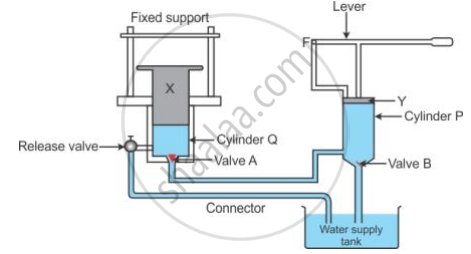
- Name the parts labelled by the letters X and Y.
- Describe what happens to valves A and B and to the quantity of water in the two cylinders when the lever arm is moved down.
- Give reasons for what happens to valves A and B in part (ii).
- What happens when the release valve is opened?
- What happens to valve B in cylinder P when the lever arm is moved up?
- Give a reason for your answer in part (v).
- State one use of the above device.
The pressure of water on the ground floor is 40,000 Pa and on the first floor is 10,000 Pa. Find the height of the first floor. (Take : density of water = 1000 kg m-3, g = 10 m s-2)
In what direction and at what point does the buoyant force on a body due to a liquid act?
The S.I. unit of upthrust is :
A body will sink if the weight of the body is greater than the buoyant force.
If the buoyant force is less, the object will float.
Complete the analogy.
Downward force : Weight :: Upward force offered by liquid : ______
