Advertisements
Online Mock Tests
Chapters
▶ 2: Periodic Classification of Element
3: Chemical reactions and equations
4: Effects of electric current
5: Heat
6: Refraction of light
7: Lenses
8: Metallurgy
9: Carbon Compounds
10: Space Missions
![Balbharati solutions for सायन्स अँड टेक्नॉलोजी पार्ट १ [इंग्रजी] इयत्ता १० महाराष्ट्र राज्य मंडळ chapter 2 - Periodic Classification of Element - Shaalaa.com](/images/science-and-technology-part-1-english-standard-10-maharashtra-state-board_6:c9a4ae86c3724b9b8c519cd188fdfa1f.jpg "Balbharati solutions for सायन्स अँड टेक्नॉलोजी पार्ट १ [इंग्रजी] इयत्ता १० महाराष्ट्र राज्य मंडळ chapter 2 - Periodic Classification of Element")
Advertisements
Solutions for Chapter 2: Periodic Classification of Element
Below listed, you can find solutions for Chapter 2 of Maharashtra State Board Balbharati for सायन्स अँड टेक्नॉलोजी पार्ट १ [इंग्रजी] इयत्ता १० महाराष्ट्र राज्य मंडळ.
Balbharati solutions for सायन्स अँड टेक्नॉलोजी पार्ट १ [इंग्रजी] इयत्ता १० महाराष्ट्र राज्य मंडळ 2 Periodic Classification of Element Intext Questions [Pages 16 - 27]
Can you recall?
What are the types of matter?
What are the types of elements?
What are the smallest particles of matter called?
What is the difference between the molecule of an element and the molecule of a compound? Give one example of each.
Can you tell?
Identify Dobereiner’s triad from the following groups of elements having similar chemical properties.
- Mg (24.3), Ca (40.1), Sr (87.6)
- S (32.1), Se (79.0), Te (127.6)
- Be (9.0), Mg (24.3), Ca (40.1)
Think about it
There are some vacant places in the Mendeleev’s periodic table. In some of these places the atomic masses are seen to be predicted. Enlist three of these predicted atomic masses along with their group and period.
Due to uncertainty in the names of some of the elements, a question mark is indicated before the symbol in the Mendeleev’s periodic table. What are such symbols?
Use your brain power!
Chlorine has two isotopes, viz, C1-35 and C1-37. Their atomic masses are 35 and 37 respectively. Their chemical properties are same. Where should these be placed in Mendeleev’s periodic table? In different places or in the same place?
Use your brain power!
Write the molecular formulae of oxides of the following elements by referring to the Mendeleev’s periodic table.
Na, Si, Ca, C, Rb, P, Ba, Cl, Sn.
Write the molecular formulae of the compounds of the following elements with hydrogen by referring to the Mendeleev’s periodic table.
C, S, Br, As, F, O, N, Cl
Use your brain power!
Position of the elements in the periodic elements......
How is the problem regarding the position of cobalt (59Co) and nickel (59Ni) in Mendeleev’s periodic table resolved in modern periodic table?
Position of the elements in the periodic elements......
How did the position of \[_{17}^{35}\text{Cl and} \phantom{.} _{17}^{37}\text{Cl}\] get fixed in the modern periodic table?
Position of the elements in the periodic elements......
Can there be an element with atomic mass 53 or 54 in between the two elements, chromium \[_{24}^{52}\text{Cr and manganese} \phantom{.} _{25}^{55}\text{Mn}\]?
What do you think? Should hydrogen be placed in the group 17 of halogens or group 1 of alkali metals in the modern periodic table?
Can you tell?
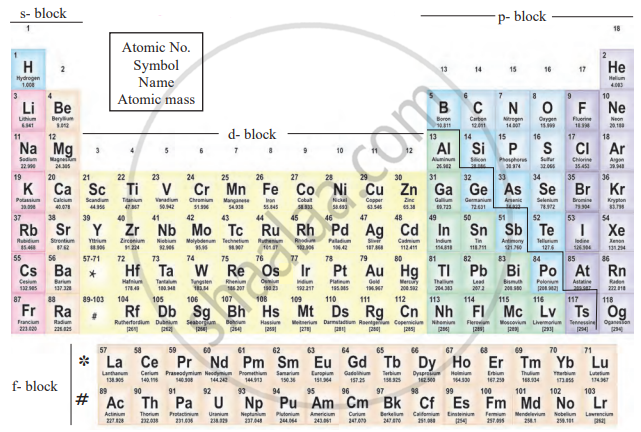
- Go through the modern periodic table and write the names one below the other of the elements of group 1.
- Write the electronic configuration of the first four elements in this group.
- Which similarity do you find in their configuration?
- How many valence electrons are there in each of these elements?
Can you tell?
- On going through the modern periodic table it is seen that the elements Li, Be, B, C, N, O, F and Ne belong to the period-2. Write down electronic configuration of all of them.
- Is the number of valence electrons same for all these elements?
- Is the number of shells the same in these?
Can you recall?
What are the values of ‘n’ for the shell K?
What are the values of ‘n’ for the shell L?
What are the values of ‘n’ for the shell M?
What is the maximum number of electrons that can be accommodated in a shell? Write the formula.
Deduce the maximum electron capacity of the shell K.
Deduce the maximum electron capacity of the shell L.
Deduce the maximum electron capacity of the shell M.
Think about it
What is the relationship between the electronic configuration of an element and its valency?
The atomic number of beryllium is 4 while that of oxygen is 8. Write down the electronic configuration of the two and deduce their valency from the same.
The table given below is made on the basis of the modern periodic table. Write in it the electronic configuration of the first 20 elements below the symbol, and write the valency (as shown in a separate box).
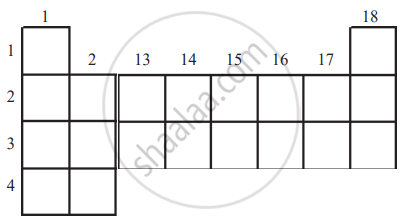
| Symbol Electronic configuration Valency |
19K 2, 8, 8, 1 1 |
What is the periodic trend in the variation of valency while going from left to right within a period? Explain your answer with reference to period 2 and period 3.
What is the periodic trend in the variation of valency while going down a group? Explain your answer with reference to the group 1, group 2 and group 18.
Use your brain power!
| Element: | O | B | C | N | Be | Li |
| Atomic radius (pm): | 66 | 88 | 77 | 74 | 111 | 152 |
- By referring to the modern periodic table find out the periods to which the above elements belong.
- Arrange the above elements in a decreasing order of their atomic radii.
- Does this arrangement match with the pattern of the second period of the modern periodic table?
- Which of the above elements have the biggest and the smallest atom?
- What is the periodic trend observed in the variation of atomic radius while going from left to right within a period?
Use your brain power!
| Element: | K | Na | Rb | Cs | Li |
| Atomic radius (pm): | 231 | 186 | 244 | 262 | 152 |
- By referring to the modern periodic table find out the groups to which above the elements belong.
- Arrange the above elements vertically downwards in an increasing order of atomic radii.
- Does this arrangement match with the pattern of the group 1 of the modern periodic table?
- Which of the above elements have the biggest and the smallest atom?
- What is the periodic trend observed in the variation of atomic radii down a group?
Use your brain power!
- Look at the elements of the third period. Classify them into metals and nonmetals.
- On which side of the period are the metals? Left or right?
- On which side of the period did you find the nonmetals?
Use your brain power!
What is the cause of nonmetallic character of elements?
What is the expected trend in the variation of nonmetallic character of elements from left to right in a period?
What would be the expected trend in the variation of nonmetallic character of elements down a group?
Balbharati solutions for सायन्स अँड टेक्नॉलोजी पार्ट १ [इंग्रजी] इयत्ता १० महाराष्ट्र राज्य मंडळ 2 Periodic Classification of Element Exercise [Pages 28 - 29]
Rearrange the columns 2 and 3 so as to match with the column 1.
| Column 1 | Column 2 | Column 3 |
| i. Triad | a. Lightest and negatively charged particle in all the atoms | 1. Mendeleev |
| ii. Octave | b. Concentrated mass and positive charge | 2. Thomson |
| iii. Atomic number | c. Average of the first and the third atomic mass | 3. Newlands |
| iv. Period | d. Properties of the eighth element similar to the first | 4. Rutherford |
| v. Nucleus | e. Positive charge on the nucleus | 5. Dobereiner |
| vi. Electron | f. Sequential change in molecular formulae | 6. Moseley |
Choose the correct option and rewrite the statement.
The number of electrons in the outermost shell of alkali metals is ______.
1
2
3
7
Alkaline earth metals have valency 2. This means that their position in the modern periodic table is in ______.
Group 2
Group 16
Period 2
d-block
The molecular formula of the chloride of element X is XCl. This compound is a solid having a high melting point. Which of the following elements be present in the same group as X.
Na
Mg
Al
Si
In which block of the modern periodic table are the nonmetals found?
s-block
p-block
d-block
f-block
An element has its electron configuration as 2, 8, 2. Now answer the following question.
What is the atomic number of this element?
An element has its electron configuration as 2, 8, 2. Now answer the following question.
What is the group of this element?
An element has its electron configuration as 2, 8, 2. Now answer the following question.
To which period does this element belong?
An element has its electron configuration as 2, 8, 2. Now answer the following question.
Which of the following elements would this element resemble?
(Atomic numbers are given in the brackets)
N(7), Be(4), Ar(18), Cl(17)
Write down the electronic configuration of the following elements from the given atomic numbers. Answer the following question with explanation.
3Li, 14Si, 2He, 11Na, 15P Which of these elements belong to be period 3?
Write down the electronic configuration of the following elements from the given atomic numbers. Answer the following question with explanation.
1H, 7N, 20Ca, 16S, 4Be, 18Ar Which of these elements belong to the second group?
Write down the electronic configuration of the following elements from the given atomic numbers. Answer the following question with explanation.
7N, 6C, 8O, 5B, 13Al Which is the most electronegative element among these?
Write down the electronic configuration of the following elements from the given atomic numbers. Answer the following question with explanation.
4Be, 6C, 8O, 5B, 13Al Which is the most electropositive element among these?
Write down the electronic configuration of the following elements from the given atomic numbers. Answer the following question with explanation.
11Na, 15P, 17Cl, 14Si, 12Mg Which of these has largest atoms?
Write down the electronic configuration of the following elements from the given atomic numbers. Answer the following question with explanation.
19K, 3Li, 11Na, 4Be Which of these atoms has smallest atomic radius?
Write down the electronic configuration of the following elements from the given atomic numbers. Answer the following question with an explanation.
13Al, 14Si, 11Na, 12Mg, 16S
Which of the above elements has the highest metallic character?
Write down the electronic configuration of the following elements from the given atomic numbers. Answer the following question with explanation.
6C, 3Li, 9F, 7N, 8O Which of the above elements has the highest nonmetallic character?
Write the name and symbol of the element from the description.
The atom having the smallest size.
Write the name and symbol of the element from the description.
The atom having the smallest atomic mass.
Write the name and symbol of the element from the description.
The most electronegative atom.
Write the name and symbol of the element from the description.
The noble gas with the smallest atomic radius.
Write the name and symbol of the element from the description.
The most reactive nonmetal.
Write a short note.
Mendeleev’s periodic law.
Write a short note.
Structure of the modern periodic table.
Write a short note.
Position of isotopes in the Mendeleev’s and the modern periodic table.
Give scientific reasons for the following:
Atomic radius goes on decreasing while going from left to right in a period.
Write a scientific reason.
Metallic character goes on decreasing while going from left to right in a period.
Write a scientific reason.
Atomic radius goes on increasing down a group.
Write a scientific reason.
Elements belonging to the same group have the same valency.
Write the scientific reason.
The third period contains only eight elements even though the electron capacity of the third shell is 18
Write the name from the description.
The period with electrons in the shells K, L, and M.
Write the name from the description.
The group with valency zero.
Write the name from the description.
The family of nonmetals having valency one.
Write the name from the description.
The family of metals having valency one.
Write the name from the description.
The family of metals having valency two.
Write the names from the description.
The metalloids in the second and third periods.
Write the names from the description.
Non-metals in the third period.
Write the names from the description.
Two elements having valency 4.
Project
Find out the applications of all the inert gases, prepare a chart and display it in the class.
Solutions for 2: Periodic Classification of Element
Balbharati solutions for सायन्स अँड टेक्नॉलोजी पार्ट १ [इंग्रजी] इयत्ता १० महाराष्ट्र राज्य मंडळ chapter 2 - Periodic Classification of Element
Shaalaa.com has the Maharashtra State Board Mathematics सायन्स अँड टेक्नॉलोजी पार्ट १ [इंग्रजी] इयत्ता १० महाराष्ट्र राज्य मंडळ Maharashtra State Board solutions in a manner that help students grasp basic concepts better and faster. The detailed, step-by-step solutions will help you understand the concepts better and clarify any confusion. Balbharati solutions for Mathematics सायन्स अँड टेक्नॉलोजी पार्ट १ [इंग्रजी] इयत्ता १० महाराष्ट्र राज्य मंडळ Maharashtra State Board 2 (Periodic Classification of Element) include all questions with answers and detailed explanations. This will clear students' doubts about questions and improve their application skills while preparing for board exams.
Further, we at Shaalaa.com provide such solutions so students can prepare for written exams. Balbharati textbook solutions can be a core help for self-study and provide excellent self-help guidance for students.
Concepts covered in सायन्स अँड टेक्नॉलोजी पार्ट १ [इंग्रजी] इयत्ता १० महाराष्ट्र राज्य मंडळ chapter 2 Periodic Classification of Element are Structure of the Modern Periodic Table, Modern Periodic Table and Electronic Configuration of Elements, The Modern Periodic Table, Dobereiner’s Triads, Newland's Law of Octaves, Mendeleev’s Periodic Table, Insights into Mendeleev’s Periodic Table, Modern Periodic Law, Classification of Elements, Periodic Trends in the Modern Periodic Table, Groups and Electronic Configuration, Atomic Size, Metallic and Non-metallic Characters, Gradation in Halogen Family, Periods and Electronic Configuration.
Using Balbharati सायन्स अँड टेक्नॉलोजी पार्ट १ [इंग्रजी] इयत्ता १० महाराष्ट्र राज्य मंडळ solutions Periodic Classification of Element exercise by students is an easy way to prepare for the exams, as they involve solutions arranged chapter-wise and also page-wise. The questions involved in Balbharati Solutions are essential questions that can be asked in the final exam. Maximum Maharashtra State Board सायन्स अँड टेक्नॉलोजी पार्ट १ [इंग्रजी] इयत्ता १० महाराष्ट्र राज्य मंडळ students prefer Balbharati Textbook Solutions to score more in exams.
Get the free view of Chapter 2, Periodic Classification of Element सायन्स अँड टेक्नॉलोजी पार्ट १ [इंग्रजी] इयत्ता १० महाराष्ट्र राज्य मंडळ additional questions for Mathematics सायन्स अँड टेक्नॉलोजी पार्ट १ [इंग्रजी] इयत्ता १० महाराष्ट्र राज्य मंडळ Maharashtra State Board, and you can use Shaalaa.com to keep it handy for your exam preparation.
