Advertisements
Online Mock Tests
Chapters
2: Periodic Classification of Element
▶ 3: Chemical reactions and equations
4: Effects of electric current
5: Heat
6: Refraction of light
7: Lenses
8: Metallurgy
9: Carbon Compounds
10: Space Missions
![Balbharati solutions for सायन्स अँड टेक्नॉलोजी पार्ट १ [इंग्रजी] इयत्ता १० महाराष्ट्र राज्य मंडळ chapter 3 - Chemical reactions and equations - Shaalaa.com](/images/science-and-technology-part-1-english-standard-10-maharashtra-state-board_6:c9a4ae86c3724b9b8c519cd188fdfa1f.jpg "Balbharati solutions for सायन्स अँड टेक्नॉलोजी पार्ट १ [इंग्रजी] इयत्ता १० महाराष्ट्र राज्य मंडळ chapter 3 - Chemical reactions and equations")
Advertisements
Solutions for Chapter 3: Chemical reactions and equations
Below listed, you can find solutions for Chapter 3 of Maharashtra State Board Balbharati for सायन्स अँड टेक्नॉलोजी पार्ट १ [इंग्रजी] इयत्ता १० महाराष्ट्र राज्य मंडळ.
Balbharati solutions for सायन्स अँड टेक्नॉलोजी पार्ट १ [इंग्रजी] इयत्ता १० महाराष्ट्र राज्य मंडळ 3 Chemical reactions and equations Intext Questions [Pages 30 - 44]
Can you recall?
What are the types of molecules of elements?
What are the types of molecules of compounds?
What is meant by the valency of an element?
What is the requirement for writing molecular formulae of different compounds? How are the molecular formulae of the compounds written?
Identify physical and chemical changes from the phenomena given in the following table.
| Phenomenon | Physical change | Chemical change |
| 1. Transformation of ice into water. | ||
| 2. Cooking of food. | ||
| 3. Ripening of fruit. | ||
| 4. Milk turned into curd. | ||
| 5. Evaporation of water. | ||
| 6. Digestion of food in the stomach | ||
| 7. Size reduction of naphtha balls exposed to air. | ||
| 8. Staining of Shahbad or Kadappa tile by lemon juice. | ||
| 9. Breaking of a glass object on falling from a height. |
Find out
What are the other uses of silver nitrate in everyday life?
Complete the table on the basis of the given equation.
\[\ce{AgNO3_{(aq)} + NaCl_{(aq)} -> \underset{(white)}{AgCl↓} + NaNO3_{(aq)}}\]
| Reactants (Left side) | Products (Right side) | |
| Element | Number of atoms | Number of atoms |
| Ag | ||
| N | ||
| O | ||
| Na | ||
| Cl |
Use your brain power!
Identify the reactants and products of the given equation.
\[\ce{Vegetable oil (l) + H2(g) ->[60^° C][Ni Catalyst] Vanaspathi ghee (s)}\]
Write down the steps in balancing the equation \[\ce{N2(g) + H2(g) <=> NH3(g)}\]
Write down a balanced chemical equation for the following reaction:
Calcium chloride + Sulfuric acid → Calcium sulphate + hydrogen chloride
Write down the physical state of reactants and products in following reaction.
\[\ce{SO2 + 2H2S -> 3S + 2H2O}\]
Write down the physical state of reactants and products in following reaction.
\[\ce{2Ag + 2HCl -> 2AgCl + H2}\]
Use your brain power!
\[\ce{\underset{Ammonia}{NH3(g)} + \underset{Hydrogen chloride}{HCl(g)} -> \underset{Ammonium chloride}{NH4Cl(s)}}\]
\[\ce{2Mg + O2 -> 2MgO}\]
\[\ce{\underset{Calcium oxide}{CaO} + \underset{water}{H2O} -> \underset{Calcium hydroxide}{Ca(OH)2} + Heat}\]
- What is the number of reactants in each of the above reactions?
- What is the number of molecules of reactants taking part in the above reactions?
- How many products are formed in each of the above reactions?
Can you recall?
Is it possible to produce hydrogen by decomposition of water by means of heat, electricity or light?
Use your brain power!
Complete the following reaction and give name of products:
CuSO4(aq) + Fe(s) → ______ + ______
Complete the following reaction and give name of products:
CuSO4 (aq) + Pb(s) → ............. + .............
Use your brain power!
What is the difference in the process of dissolution and a chemical reaction?
Does a new substance form when a solute dissolves in a solvent?
Use your brain power!
Which is the oxidant used for purification of drinking water?
Why is potassium permanganate used during cleaning water tanks?
Use your brain power!
Some more examples of redox reaction are as follows. Identify the reductants and oxidants from them.
\[\ce{2H2S + SO2 -> 3S↓ + 2H2O}\]
\[\ce{MnO2 + 4HCl -> MnCl2 + 2H2O + Cl2↑}\]
If oxidation means losing electrons, what is meant by reduction?
Write the reaction of formation of Fe2+ by reduction Fe3+ by making use of the symbol (e-).
Think about it
The luster of the surface of the aluminium utensils in the house is lost after a few days. Why does this happen?
Find out
How are the blackened silver utensils and patinated (greenish) brass utensils cleaned?
Balbharati solutions for सायन्स अँड टेक्नॉलोजी पार्ट १ [इंग्रजी] इयत्ता १० महाराष्ट्र राज्य मंडळ 3 Chemical reactions and equations Exercise [Pages 45 - 46]
Choose the correct option from the bracket and explain the statement giving reason.
(Oxidation, displacement, electrolysis, reduction, zinc, copper, double displacement, decomposition)
To prevent rusting, a layer of ______ metal is applied on iron sheets.
Choose the correct option from the bracket and explain the statement giving reason.
(Oxidation, displacement, electrolysis, reduction, zinc, copper, double displacement, decomposition)
The conversion of ferrous sulphate to ferric sulphate is ______ reaction.
When electric current is passed through acidulated water ______ of water takes place.
Oxidation
Displacement
Electrolysis
Reduction
zinc
copper
Double displacement
Decomposition
Choose the correct option from the bracket and explain the statement giving a reason.
(Oxidation, displacement, electrolysis, reduction, zinc, copper, double displacement, decomposition)
Addition of an aqueous solution of ZnSO4 to an aqueous solution of BaCl2 is an example of ______ reaction.
Write answer to the following.
What is the reaction called when oxidation and reduction take place simultaneously? Explain with one example.
How can the rate of the chemical reaction, namely, decomposition of hydrogen peroxide be increased?
Explain the term reactant and product giving examples.
Explain the types of reaction with reference to oxygen and hydrogen. Illustratre with examples.
Write the answer to the following.
Explain the similarity in two events, namely adding NaOH to water and adding CaO to water.
Write the answer to the following.
Explain the difference in two events, namely adding NaOH to water and adding CaO to water.
Explain the term with examples.
Endothermic reaction
Explain the terms with examples.
Combination reaction
Explain the terms with examples.
Balanced equation
Explain the terms with examples.
Displacement reaction
Give a scientific reason.
When the gas formed on heating limestone is passed through freshly prepared lime water, the lime water turns milky.
Give scientific reason.
It takes time for pieces of Shahabad tile to disappear in HCl, but its powder disappears rapidly.
Give scientific reason.
While preparing dilute sulphuric acid from concentrated sulphuric acid in the laboratory, the concentrated sulphuric acid is added slowly to water with constant stirring.
Give scientific reason.
It is reccommended to use air tight container for storing oil for long time.
Observe the following picture a write down the chemical reaction with the explanation.
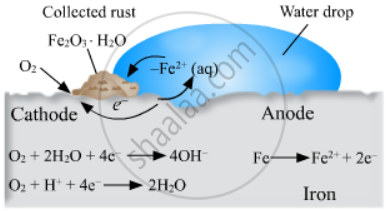
Identify from the reaction the reactants that undergo oxidation and reduction.
Fe + S → FeS
Identify from the following reaction the reactants that undergo oxidation and reduction.
\[\ce{2Ag2O → 4 Ag + O2 \uparrow}\]
Identify from the reaction the reactants that undergo oxidation and reduction.
2Mg + O2 → 2MgO
Identify from the reaction the reactants that undergo oxidation and reduction.
\[\ce{NiO + H2 -> Ni + H2O}\]
Balance the equation stepwise.
H2S2O7(l) + H2O(l) → H2SO4(l)
Balance the equation stepwise.
SO2(g) + H2S(aq) → S(s) + H2O(l)
Balance the equation stepwise.
Ag(s) + HCl(aq) → AgCl ↓+ H2 ↑
Balance the equation stepwise.
NaOH(aq) + H2SO4(aq) → Na2SO4(aq) + H2O(l)
Identify the endothermic and exothermic reaction.
HCl + NaOH → NaCl + H2O + heat
Exothermic reaction
Endothermic reaction
Identify the endothermic and exothermic reaction.
\[\ce{2KClO_{3(s)}->[\Delta] 2KCl_{(s)} + 3O2}\]
Exothermic reaction
Endothermic reaction
Identify the endothermic and exothermic reaction.
\[\ce{CaO + H2O -> Ca(OH)2 + Heat}\]
Exothermic reaction
Endothermic reaction
Identify the endothermic and exothermic reaction.
\[\ce{CaCO_{3(s)}->[\Delta] CaO_{(s)} + CO2}\]
Exothermic reaction
Endothermic reaction
Match the column in the following table.
| Reactants | Products | Type of chemical reaction |
| BaCl2(aq) + ZnSO4(aq) | H2CO3(aq) | Displacement |
| 2AgCl(s) | FeSO4(aq) + Cu(s) | Combination |
| CuSO4(aq) + Fe(s) | BaSO4↓ + ZnCl2(aq) | Decomposition |
| H2O(l) + CO2(g) | 2Ag(s) + Cl2(g) | Double displacement |
Solutions for 3: Chemical reactions and equations
Balbharati solutions for सायन्स अँड टेक्नॉलोजी पार्ट १ [इंग्रजी] इयत्ता १० महाराष्ट्र राज्य मंडळ chapter 3 - Chemical reactions and equations
Shaalaa.com has the Maharashtra State Board Mathematics सायन्स अँड टेक्नॉलोजी पार्ट १ [इंग्रजी] इयत्ता १० महाराष्ट्र राज्य मंडळ Maharashtra State Board solutions in a manner that help students grasp basic concepts better and faster. The detailed, step-by-step solutions will help you understand the concepts better and clarify any confusion. Balbharati solutions for Mathematics सायन्स अँड टेक्नॉलोजी पार्ट १ [इंग्रजी] इयत्ता १० महाराष्ट्र राज्य मंडळ Maharashtra State Board 3 (Chemical reactions and equations) include all questions with answers and detailed explanations. This will clear students' doubts about questions and improve their application skills while preparing for board exams.
Further, we at Shaalaa.com provide such solutions so students can prepare for written exams. Balbharati textbook solutions can be a core help for self-study and provide excellent self-help guidance for students.
Concepts covered in सायन्स अँड टेक्नॉलोजी पार्ट १ [इंग्रजी] इयत्ता १० महाराष्ट्र राज्य मंडळ chapter 3 Chemical reactions and equations are Chemical Reaction, Chemical Equations, Types of Chemical Reactions > Combination Reaction, Types of Chemical Reactions > Decomposition Reaction, Types of Chemical Reactions > Single Displacement Reaction, Rancidity, Types of Chemical Reactions > Double Displacement Reaction, Corrosion of Metals, Balancing Chemical Equation, Factors Affecting the Rate of a Chemical Reaction, Chemical Properties of Carbon Compounds > Reduction, Endothermic and Exothermic Processes, Rate of Chemical Reaction, Chemical Properties of Carbon Compounds > Oxidation.
Using Balbharati सायन्स अँड टेक्नॉलोजी पार्ट १ [इंग्रजी] इयत्ता १० महाराष्ट्र राज्य मंडळ solutions Chemical reactions and equations exercise by students is an easy way to prepare for the exams, as they involve solutions arranged chapter-wise and also page-wise. The questions involved in Balbharati Solutions are essential questions that can be asked in the final exam. Maximum Maharashtra State Board सायन्स अँड टेक्नॉलोजी पार्ट १ [इंग्रजी] इयत्ता १० महाराष्ट्र राज्य मंडळ students prefer Balbharati Textbook Solutions to score more in exams.
Get the free view of Chapter 3, Chemical reactions and equations सायन्स अँड टेक्नॉलोजी पार्ट १ [इंग्रजी] इयत्ता १० महाराष्ट्र राज्य मंडळ additional questions for Mathematics सायन्स अँड टेक्नॉलोजी पार्ट १ [इंग्रजी] इयत्ता १० महाराष्ट्र राज्य मंडळ Maharashtra State Board, and you can use Shaalaa.com to keep it handy for your exam preparation.
