Advertisements
Advertisements
प्रश्न
Give a scientific reason.
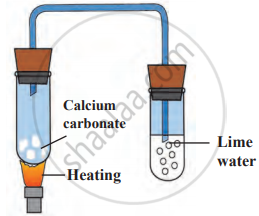
When the gas formed on heating limestone is passed through freshly prepared lime water, the lime water turns milky.
Advertisements
उत्तर
- When limestone is heated, calcium oxide and carbon dioxide gas are formed.
\[\ce{\underset{\text{carbonate}}{\underset{\text{Calcium}}{CaCO_{3(s)}}} + Heat -> \underset{\text{oxide}}{\underset{\text{Calcium}}{CaO_{(s)}}} + \underset{\text{dioxide}}{\underset{\text{Carbon}}{CO2\uparrow}}}\] - When carbon dioxide gas is passed through freshly prepared lime water, the solution turns milky due to the formation of calcium carbonate, which is insoluble in water.
\[\ce{\underset{\text{hydroxide}}{\underset{\text{Calcium}}{Ca(OH)2_{(aq)}}} + \underset{\text{dioxide}}{\underset{\text{Carbon}}{CO_{2(g)}}} -> \underset{\text{carbonate}}{\underset{\text{Calcium}}{CaCO_{3(s)}}} + \underset{\text{Water}}{H2O_{(l)}}}\]
APPEARS IN
संबंधित प्रश्न
Write the balanced chemical equation for the following and identify the type of reaction.
\[\ce{Zinc carbonate(s) -> Zinc oxide(s) + Carbon dioxide(g)}\]
Why are decomposition reactions called the opposite of combination reactions? Write equations for these reactions.
The white solid compound A decomposes quite rapidly on heating in the presence of a black substance X to form a solid compound B and a gas C. When an aqueous solution of compound B is reacted with silver nitrate solution, then a white precipitate of silver chloride is obtained along with potassium nitrate solution. Gas C does not burn itself but helps burn other things.
- What is compound A?
- What is compound B?
- What is gas C?
- What do you think is the black substance X? What is its function?
- What is the general name of substances like X?
State an important use of decomposition reactions.
Give one example of a decomposition reaction which is carried out by applying heat.
Give one example of a decomposition reaction which is carried out with electricity.
What type of chemical reaction is used to extract metals from their naturally occurring compounds like oxides or chlorides?
What type of reaction is represented by the following equation?
\[\ce{CaCO3 -> CaO + CO2}\]
What type of chemical reaction takes place when limestone is heated?
Name the product formed on strongly heating ferrous sulphate crystals. What type of chemical reaction occurs in this change?
State the change in colour observed in the following case, mentioning the reason:
Silver chloride is exposed to sunlight.
Two metals X and Y form the salts XSO4 and Y2SO4, respectively. The solution of salt XSO4 is blue in colour whereas that of Y2SO4 is colourless. When barium chloride solution is added to XSO4 solution, then a white precipitate Z is formed along with a salt which turns the solution green. And when barium chloride solution is added to Y2SO4 solution, then the same white precipitate Z is formed along with colourless common salt solution.
- What could the metals X and Y be?
- Write the name and formula of salt XSO4.
- Write the name and formula of salt Y2SO4.
- What is the name and formula of white precipitate Z?
- Write the name and formula of the salt which turns the solution green in the first case.
A metal salt MX when exposed to light splits up to form metal M and a gas X2. Metal M is used in making ornaments whereas gas X2 is used in making bleaching powder. The salt MX is itself used in black and white photography.
- What do you think metal M is?
- What could be gas X2?
- Name the metal salt MX.
- Name any two salt solutions which on mixing together can produce a precipitate of salt MX.
- What type of chemical reaction takes place when salt MX is exposed to light? Write the equation of the reaction.
Classify the following reaction as combination, decomposition, displacement, precipitation and neutralization. Also balance the equation.
\[\ce{Zn_{(s)} + H2SO4 -> ZnSO4_{(s)} + H2_{(g)}}\]
(a) Design an activity to demonstrate the decomposition reaction of lead nitrate.
(b) Draw labelled diagram of the experimental set-up. List two main observations.
(c) Write balanced chemical equation for the reaction stating the physical state of the reactant and the products.
A student wants to study a decomposition reaction by taking ferrous sulphate crystals. Write two precautions he must observe while performing the experiment.
How can the rate of the chemical reaction, namely, decomposition of hydrogen peroxide be increased?
Classify the following reaction into –
- Direct combination
- Decomposition
- Displacement
- Double decomposition
The reaction is – Zinc hydroxide on heating gives zinc oxide and water.
Give a balanced equation for –
A thermal decomposition reaction involving heat on limestone [calcium carbonate]
Give a balanced equation for –
An electrolytic decomposition reaction involving a neutral liquid
Give a balanced equation for –
A white precipitate obtained during a double decomposition reaction involving a silver salt with sodium salt.
Complete the statement by filling in the blank with the correct word:
Decomposition of silver salts in the presence of sunlight is an example of _________.
Give a balanced equation for the following type of reaction:
A thermal decomposition reaction in which a metallic nitrate decomposes to give – a basic oxide.
What is electrolysis?
Explain the reaction given in the figure.
Electrolysis is type of ______ reaction.
The following reaction is used for the preparation of oxygen gas in the laboratory:
\[\ce{2KClO3_{(s)} ->[Heat] 2KCl + 3O2_{(g)}}\]
Which of the following statement about the reaction is correct?
Balance the following chemical equation and identify the type of chemical reaction.
`"HgO"("s") overset("(heat)")(->) "Hg"("l") + "O"_2("g")`
These consist of two statements – Assertion (A) and Reason (R). Answer these questions selecting the appropriate option given below:
Assertion: Silver bromide decomposition is used in black and white photography.
Reason: Light provides energy for this exothermic reaction.
Complete the following reaction:
\[\ce{C_12H_22O11->[Heat]}\] ______ + ______.
What is observed when silver chloride is exposed to sunlight? Give the type of reaction involved.
Write one equation for the decomposition reaction where energy is supplied in the form of light.
A solution of a substance ‘X’ is used for whitewashing.
- Name the substance ‘X’ and write its formula.
- Write the reaction of the substance ‘X’ named in the above formula with water.
