Advertisements
Advertisements
Question
Give a scientific reason.
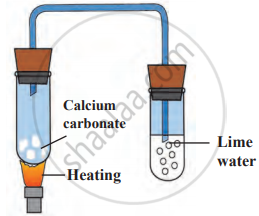
When the gas formed on heating limestone is passed through freshly prepared lime water, the lime water turns milky.
Advertisements
Solution
- When limestone is heated, calcium oxide and carbon dioxide gas are formed.
\[\ce{\underset{\text{carbonate}}{\underset{\text{Calcium}}{CaCO_{3(s)}}} + Heat -> \underset{\text{oxide}}{\underset{\text{Calcium}}{CaO_{(s)}}} + \underset{\text{dioxide}}{\underset{\text{Carbon}}{CO2\uparrow}}}\] - When carbon dioxide gas is passed through freshly prepared lime water, the solution turns milky due to the formation of calcium carbonate, which is insoluble in water.
\[\ce{\underset{\text{hydroxide}}{\underset{\text{Calcium}}{Ca(OH)2_{(aq)}}} + \underset{\text{dioxide}}{\underset{\text{Carbon}}{CO_{2(g)}}} -> \underset{\text{carbonate}}{\underset{\text{Calcium}}{CaCO_{3(s)}}} + \underset{\text{Water}}{H2O_{(l)}}}\]
APPEARS IN
RELATED QUESTIONS
Write one equation for decomposition reactions where energy is supplied in the form of heat.
Taking into consideration the relationship in the first pair, complete the second pair
2H2 + O2 → 2H2O :Combination Reaction :: 2HgO → 2Hg + O2:_________
Rewrite the following statements by selecting the correct options:
\[\ce{CaCO3 ->[\Delta] CaO + CO2 ^}\] is a __________ reaction.
What type of chemical reaction is used to extract metals from their naturally occurring compounds like oxides or chlorides?
What type of reaction is represented by the following equation?
\[\ce{2FeSO4 -> Fe2O3 + SO2 + SO3}\]
What type of reaction is represented by the following equation?
\[\ce{NH4Cl -> NH3 + HCl}\]
What type of chemical reaction takes place when silver bromide is exposed to sunlight?
What type of reaction is represented by the following equation?
\[\ce{NH4NO2 -> N2 + 2H2O}\]
What is the colour of ferrous sulphate crystals? How does this colour change after heating?
A metal salt MX when exposed to light splits up to form metal M and a gas X2. Metal M is used in making ornaments whereas gas X2 is used in making bleaching powder. The salt MX is itself used in black and white photography.
- What do you think metal M is?
- What could be gas X2?
- Name the metal salt MX.
- Name any two salt solutions which on mixing together can produce a precipitate of salt MX.
- What type of chemical reaction takes place when salt MX is exposed to light? Write the equation of the reaction.
Classify the following reaction as combination, decomposition, displacement, precipitation and neutralization. Also balance the equation.
\[\ce{Zn_{(s)} + H2SO4 -> ZnSO4_{(s)} + H2_{(g)}}\]
How will you obtain Nitrogen dioxide from lead nitrate.
Also give balanced equations for the reactions
How can the rate of the chemical reaction, namely, decomposition of hydrogen peroxide be increased?
Classify the following reaction into different type:
\[\ce{2KClO3(s)->[\Delta] 2KCl(aq) + 3O2(g)}\]
Differentiate between direct combination reaction and a decomposition reaction.
Give a balanced equation for the following type of reaction:
A thermal decomposition reaction in which a metallic nitrate decomposes to give – a basic oxide.
The chemical reaction in which two or more products are formed from a single reactant is called ______ reaction.
Explain the reaction given in the figure.
Electrolysis is type of ______ reaction.
Chemical volcano is an example of ______ type of reaction.
Electrolysis of water is a decomposition reaction. The mole ratio of hydrogen and oxygen gases liberated during electrolysis of water is:
When SO2 gas is passed through a saturated solution of H2S, which of the following reaction occurs?
Assertion: Decomposition of vegetable matter into compost is an endothermic reaction.
Reason: Decomposition reaction involves breakdown of a single reactant into simpler products.
Marble statues are corroded or stained rain water. Identify the main reason.

Balance the following chemical equation and identify the type of chemical reaction.
`"HgO"("s") overset("(heat)")(->) "Hg"("l") + "O"_2("g")`

- Identify the gasses evolved at the anode and cathode in the above experimental set up.
- Name the process that occurs. Why is it called so?
- Illustrate the reaction of the process with the help of a chemical equation.
A metal nitrate 'A' on heating gives a metal oxide along with evolution of a brown coloured gas 'B' and a colourless gas, which helps in burning. Aqueous solution of 'A' when reacted with potassium iodide forms a yellow precipitate.
- Identify 'A' and 'B'
- Name the types of the reactions involved in the above statement.
What is observed when silver chloride is exposed to sunlight? Give the type of reaction involved.
When lead nitrate is heated strongly in a boiling tube, two gases are liberated and a solid residue is left behind in the test tube.
- Name the type of chemical reaction and define it.
- Write the name and formula of the coloured gas liberated.
- Write the balanced chemical equation for the reaction.
- Name the residue left in the test tube and state the method of testing its nature (acidic/basic).
Write one equation for the decomposition reaction where energy is supplied in the form of light.
Write one equation for the decomposition reaction where energy is supplied in the form of electricity.
