Advertisements
Advertisements
Question
How can the rate of the chemical reaction, namely, decomposition of hydrogen peroxide be increased?
Advertisements
Solution
\[\ce{\underset{peroxide}{\underset{Hydrogen}{2H2O}_{2(l)}} -> \underset{water}{2H2O} + \underset{oxygen}{O2\uparrow}}\]
- The decomposition of hydrogen peroxide (H2O2) into water and oxygen takes place slowly at room temperature.
- However, hydrogen peroxide decomposes rapidly in the presence of manganese dioxide (MnO2) powder, which acts as a catalyst.
- Thus, by adding manganese dioxide (MnO2) powder, the rate of a chemical reaction can be increased.
APPEARS IN
RELATED QUESTIONS
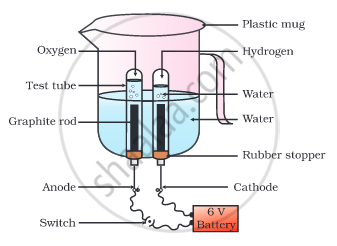
Why is the amount of gas collected in one of the test tubes in the following Activity double of the amount collected in the other? Name this gas.
- Take a plastic mug. Drill two holes at its base and fit rubber stoppers in these holes. Insert carbon electrodes in these rubber stoppers as shown in the following Fig.
- Connect these electrodes to a 6 volt battery.
- Fill the mug with water such that the electrodes are immersed. Add a few drops of dilute sulphuric acid to the water.
- Take two test tubes filled with water and invert them over the two carbon electrodes.
- Switch on the current and leave the apparatus undisturbed for some time.
- You will observe the formation of bubbles at both the electrodes. These bubbles displace water in the test tubes.
- Is the volume of the gas collected the same in both the test tubes?
• Once the test tubes are filled with the respective gases, remove them carefully. - Test these gases one by one by bringing a burning candle close to the mouth of the test tubes.
Caution: This step must be performed carefully by the teacher.
- What happens in each case?
- Which gas is present in each test tube?
Write the balanced chemical equation for the following and identify the type of reaction.
\[\ce{Zinc carbonate(s) -> Zinc oxide(s) + Carbon dioxide(g)}\]
Write one equation for decomposition reactions where energy is supplied in the form of heat.
Decomposition reactions require energy either in the form of heat or light or electricity for breaking down the reactants. Write one equation each for decomposition reactions where energy is supplied in the form of heat, light and electricity
The white solid compound A decomposes quite rapidly on heating in the presence of a black substance X to form a solid compound B and a gas C. When an aqueous solution of compound B is reacted with silver nitrate solution, then a white precipitate of silver chloride is obtained along with potassium nitrate solution. Gas C does not burn itself but helps burn other things.
- What is compound A?
- What is compound B?
- What is gas C?
- What do you think is the black substance X? What is its function?
- What is the general name of substances like X?
Give one example of a decomposition reaction which is carried out by applying heat.
Give one example of a decomposition reaction which is carried out with electricity.
What type of reaction is represented by the following equation?
\[\ce{2FeSO4 -> Fe2O3 + SO2 + SO3}\]
What type of reaction is represented by the following equation?
\[\ce{NH4Cl -> NH3 + HCl}\]
What type of reaction is represented by the following equation?
\[\ce{NH4NO2 -> N2 + 2H2O}\]
What is the colour of ferrous sulphate crystals? How does this colour change after heating?
Name the product formed on strongly heating ferrous sulphate crystals. What type of chemical reaction occurs in this change?
What is meant by a decomposition reaction?
State the change in colour observed in the following case, mentioning the reason:
Silver chloride is exposed to sunlight.
Which of the following can be decomposed by the action of light?
When a green iron salt is heated strongly, its colour finally changes to brown and odour of burning sulphur is given out.
- Name the iron salt.
- Name the type of reaction that takes place during the heating of iron salt.
- Write a chemical equation for the reaction involved.
What does one mean by endothermic reaction? Give example.
A student wants to study a decomposition reaction by taking ferrous sulphate crystals. Write two precautions he must observe while performing the experiment.
Differentiate between direct combination reaction and a decomposition reaction.
Classify the following reaction into –
- Direct combination
- Decomposition
- Displacement
- Double decomposition
The reaction is – Zinc hydroxide on heating gives zinc oxide and water.
Give a balanced equation for –
A double decomposition neutralization reaction involving an acid and a base
Give a balanced equation for the following type of reaction:
A thermal decomposition reaction in which a metallic nitrate decomposes to give – a basic oxide.
Differentiate between the following:
Thermal decomposition and thermal dissociation.
Electrolysis of water is a decomposition reaction. The mole ratio of hydrogen and oxygen gases liberated during electrolysis of water is:
Give the ratio in which hydrogen and oxygen are present in water by volume.
Which of the following is an endothermic process?
These consist of two statements – Assertion (A) and Reason (R). Answer these questions selecting the appropriate option given below:
Assertion: Silver bromide decomposition is used in black and white photography.
Reason: Light provides energy for this exothermic reaction.
Complete the following reaction:
\[\ce{C_12H_22O11->[Heat]}\] ______ + ______.
What is observed when silver chloride is exposed to sunlight? Give the type of reaction involved.
When lead nitrate is heated strongly in a boiling tube, two gases are liberated and a solid residue is left behind in the test tube.
- Name the type of chemical reaction and define it.
- Write the name and formula of the coloured gas liberated.
- Write the balanced chemical equation for the reaction.
- Name the residue left in the test tube and state the method of testing its nature (acidic/basic).
Write the molecular formula of calcium carbonate.
Write one equation for the decomposition reaction where energy is supplied in the form of electricity.
A solution of a substance ‘X’ is used for whitewashing.
- Name the substance ‘X’ and write its formula.
- Write the reaction of the substance ‘X’ named in the above formula with water.
