Advertisements
Advertisements
प्रश्न
Alkaline earth metals have valency 2. This means that their position in the modern periodic table is in ______.
पर्याय
Group 2
Group 16
Period 2
d-block
Advertisements
उत्तर
Alkaline earth metals have valency 2. This means that their position in the modern periodic table is in Group 2.
Explanation:
Alkaline Earth Metals include Beryllium (Be), Magnesium (Mg), Calcium (Ca), Strontium (Sr), Barium (Ba), and Radium (Ra). These elements have valency 2 because they have two electrons in their outermost shell (s-orbital). In the Modern Periodic Table, elements are arranged in groups and periods based on their electronic configuration. All Alkaline Earth Metals belong to Group 2.
APPEARS IN
संबंधित प्रश्न
The element which can from an acidic oxide should be the one whose atomic number is:
(a) 6
(b) 16
(c) 12
(d) 19
As element X has mass number 40 and contains 21 neutrons in its atom. To which group of the periodic table does it belong?
Write the names and symbols of two very reactive metals belonging to group 1 of the periodic table. Explain by drawing electronic structure, how either one of the two metals reacts with a halogen. With which name is the bond formed between these elements known and what is the class of the compound so formed known? State any four physical properties of such compounds.
The number of electrons in the outermost shell of alkali metals is ______.
Why was this basis of classification discarded for future classification of elements?
Moseley’s periodic table is based on atomic mass.
Name the neutral atom in the Periodic Table which has the same number of electrons as K+ and Cl-.
An element X combines with oxygen to form an oxide XO. This oxide is electrically conducting. Write the formula of the compound formed when X reacts with chlorine.
Consider the following elements 20Ca, 8Or 18Ar, 16S, 4Be, 2He
Which of the above elements would you expect to be in group 16 of the Periodic Table?
The atom of an element has electronic configuration 2, 8, 7. To which of the following elements would it be chemically similar?
Which type of elements are poor conductors of heat and electricity?
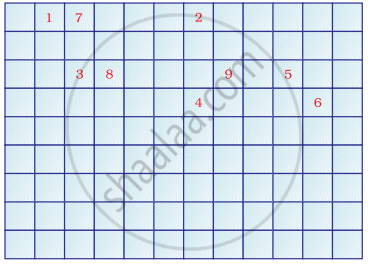
Complete the following cross word puzzle
Across:
(1) An element with atomic number 12.
(3) Metal used in making cans and member of Group 14.
(4) A lustrous non-metal which has 7 electrons in its outermost shell.
Down:
(2) Highly reactive and soft metal which imparts yellow colour when subjected to flame and is kept in kerosene.
(5) The first element of second Period
(6) An element which is used in making fluorescent bulbs and is second member of Group 18 in the Modern Periodic Table
(7) A radioactive element which is the last member of halogen family.
(8) Metal which is an important constituent of steel and forms rust when exposed to moist air.
(9) The first metalloid in Modern Periodic Table whose fibres are used in making bullet-proof vests
Which of the following metals have low melting and boiling point?
Relate the names of the following scientists with the statements given below.
Arranged elements into groups containing three elements each.
How are elements grouped into various families in the periodic table?
Identify the following:
An element in Period 1 which can be placed in both Group 1 and Group 17 of the Periodic Table.
