Advertisements
Advertisements
Taking into consideration the period of the elements given below, answer the following questions:
| Elements | Atomic Radius (pm) |
| O | 66 |
| B | 88 |
| C | 77 |
| N | 74 |
| Be | 111 |
| Li | 152 |
- Arrange the above elements in decreasing order of their atomic radii.
- State the period to which the above elements belong.
- Why this arrangement of elements is similar to the above period of modern periodic table?
- Which of the above elements have the biggest and the smallest atom?
- What is the periodic trend observed in the variation of atomic radius while going from left to right within a period?
Concept: undefined >> undefined
How can the rate of the chemical reaction, namely, decomposition of hydrogen peroxide be increased?
Concept: undefined >> undefined
Advertisements
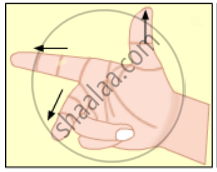
Name the following diagram and explain the concept behind it.
Concept: undefined >> undefined
State the modern periodic law.
Concept: undefined >> undefined
The equivalent resistance of a parallel combination of two resistors of 30 Ω and 60 Ω is ______________.
Concept: undefined >> undefined
(a) Fill in the blanks and rewrite the completed statements:
(i) ________ group in the periodic table contains elements that are all gases at room temperature.
(ii) Very fine particles mainly scatter ______ light.
Concept: undefined >> undefined
Differentiate between conductors and insulators.
Concept: undefined >> undefined
State Fleming’s Right Hand Rule.
Concept: undefined >> undefined
Concept: undefined >> undefined
Answer the following:
State the principles of the electric motor and electric generator.
Concept: undefined >> undefined
Fill in the blank and rewrite the completed statement:
________ group in the periodic table contains elements that are all gases at room temperature.
Concept: undefined >> undefined
If an object is placed in front of a convex lens beyond 2F1, then what will be the position, relative size, and nature of an image which is formed? Explain with a ray diagram.
Concept: undefined >> undefined
Concept: undefined >> undefined
Concept: undefined >> undefined
Concept: undefined >> undefined
Answer the following question:
State the four blocks of the modern periodic table based on the electronic configuration of elements.
Concept: undefined >> undefined
Choose the correct option:
A conductor rod of length (l) is moving with velocity (v) in a direction normal to a uniform magnetic field (B). What will be the magnitude of induced emf produced between the ends of the moving conductor?
Concept: undefined >> undefined
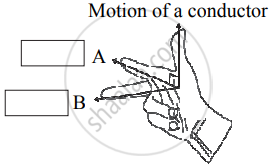
Observe the given figure of Fleming’s Right Hand Rule and write the labels of A and B correctly.
Concept: undefined >> undefined
The groups 1 and 2 constitute the _______ block.
Concept: undefined >> undefined
Which of the following statements about the Modern periodic table is correct?
Concept: undefined >> undefined
