Advertisements
Advertisements
Mention the type of host cells suitable for the gene guns to introduce an alien DNA.
Concept: Tools of Recombinant DNA Technology >> Competent Host (For Transformation with Recombinant DNA)
Suggest a technique to a researcher who needs to separate fragments of DNA.
Concept: Tools of Recombinant DNA Technology >> Restriction Enzymes
Suggest and describe a technique to obtain multiple copies of a gene of interest in vitro.
Concept: Processes of Recombinant DNA Technology
Draw a labelled sketch of sparged-stirred-tank bioreactor. Write its application.
Concept: Processes of Recombinant DNA Technology
Name the enzymes that are used for the isolation of DNA from bacterial and fungal cells for recombinant DNA technology.
Concept: Tools of Recombinant DNA Technology >> Restriction Enzymes
How does a restriction nuclease function? Explain
Concept: Tools of Recombinant DNA Technology >> Restriction Enzymes
Name and describe the technique that helps in separating the DNA fragments formed by the use of restriction endonuclease
Concept: Tools of Recombinant DNA Technology >> Restriction Enzymes
Write the steps you would suggest to be undertaken to obtain a foreign-gene-product.
Concept: Tools of Recombinant DNA Technology >> Competent Host (For Transformation with Recombinant DNA)
Cloning of genes, play a very significant role in genetic engineering, helping the transfer of desirable foreign genes into different hosts. The scientists, to make this process easier and effective are creating engineered vectors in such a way that they help easy linking of foreign DNA and selection of recombinants from non-recombinants. 'pBR322' is one such engineered vectors developed by scientists. A diagram of an engineered vector pBR322 is given below:

- Name the host for this cloning vector.
- Identify 'Rop' and 'Ori' in the diagram from 'U', 'V', 'W', 'X', 'Y' and 'Z'. Write their functions.
- Draw the fragments that will be formed by the action of 'Z' (marked in the diagram) on the specific site of the DNA segment given below:
5' --- GTACGAATCCTGA --- 3'
3' --- CATGCTTAGGACT --- 3'
Concept: Principles of Processes of Biotechnology
Given below is the stepwise schematic representation of the process of electrophoresis. Identify the 'alphabets' representing
- Anode end
- smallest/lightest DNA strand in the matrix
- Agarose gel
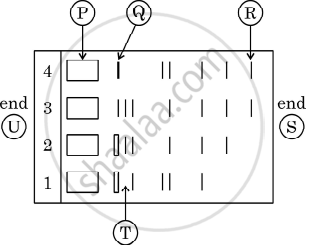
Concept: Tools of Recombinant DNA Technology >> Restriction Enzymes
What is elution?
Concept: Tools of Recombinant DNA Technology >> Restriction Enzymes
State the importance of elution in this process.
Concept: Tools of Recombinant DNA Technology >> Restriction Enzymes
Read the paragraph given below and answer and questions that follow:
| Enzyme Taq polymerase, is extracted from a eubacterial microorganism Thermus aquaticus from Yellowstone National Park in Montana, USA and isolated by Chien et al. (1976). Taq polymerase successfully replaced the DNA polymerase from E.coli that was being used in PCR earlier and this shift revolutionised the PCR technique. |
- Taq polymerase after its discovery replaced E.coli DNA polymerase in PCR technique. Explain giving reasons why was the need felt for the change?
- What is a primer and its importance in PCR?
- Write the importance of PCR as a diagnostic tool.
Concept: Processes of Recombinant DNA Technology
Read the following paragraph and answer the questions that follow:
| Biotechnology revolves around the "gene of interest", with an objective to open various avenues for human welfare in health, medicine, pharma, agriculture etc. using different techniques, tools and processes. One of the breakthroughs of biotechnology in medicine is the gene therapy. |
- Name the human disease for which the gene therapy was used for the first time.
- Explain the steps of gene therapy carried to cure the disease using the lymphocytes of the patient. Why is this therapy not a permanent cure of the disease?
- Write the possible permanent cure of the disease by the gene therapy that is in progress.
Concept: Processes of Recombinant DNA Technology
Given below is the restriction site of a restriction endonuclease Pst-I and the cleavage sites on a DNA molecule.
\[\ce{5' C - T - G - C - A \overset{\downarrow}{-}{G 3'}}\]
\[\ce{3' G\underset{\uparrow}{-} A - C - G - T - C 5'}\]
Choose the option that gives the correct resultant fragments by the action of the enzyme Pst-I.
Concept: Tools of Recombinant DNA Technology >> Restriction Enzymes
Assertion (A): Synthetic oligonucleotide polymers are used during Annealing in a PCR.
Reason (R): The primers bind to the double stranded DNA at their complementary regions.
Concept: Processes of Recombinant DNA Technology
Write the scientific name of the source organism of the thermostable DNA polymerase used in PCR.
Concept: Processes of Recombinant DNA Technology
State the advantage of using Thermostable DNA polymerase.
Concept: Processes of Recombinant DNA Technology
Bioreactors are the containment vehicles of any biotechnology-based production process. For large scale production and for economic reasons the final success of biotechnological process depends on the efficiency of the bioreactor.
Answer the following questions w.r.t. the given paragraph:
- List the operational guidelines that must be adhered to so as to achieve optimisation of the bioreactor system. Enlist any four.
- Mention the phase of the growth we refer to in the statement "Optimisation of growth and metabolic activity of the cells".
- Is the biological product formed in the bioreactor suitable for the intended use immediate? Give reason in support of your answer.
Concept: Processes of Recombinant DNA Technology
'EcoRI' has played a very significant role in rDNA technology.
- Explain the convention for naming EcoRI.
- Write the recognition site and the cleavage sites of this restriction endonuclease.
Concept: Tools of Recombinant DNA Technology >> Restriction Enzymes
