Advertisements
Advertisements
प्रश्न
Which of the following reagents can be used to oxidise primary alcohols to aldehydes?
(i) \[\ce{CrO3}\] in anhydrous medium.
(ii) \[\ce{KMnO4}\] in acidic medium.
(iii) Pyridinium chlorochromate.
(iv) Heat in the presence of Cu at 573 K.
Advertisements
उत्तर
(i) \[\ce{CrO3}\] in anhydrous medium.
(iii) Pyridinium chlorochromate.
(iv) Heat in the presence of Cu at 573 K.
Explanation:
Strong oxidising agents such as acidified potassium permanganate are used for getting carboxylic acids from alcohols directly. \[\ce{CrO3}\] in anhydrous medium is used as the oxidising agent for the isolation of aldehydes.
\[\ce{RCH2OH ->[CrO3] RCHO}\]
A better reagent for the oxidation of primary alcohols to aldehydes in good yield is pyridinium chlorochromate (PCC), a complex for chromium trioxide with pyridine and HCl.
APPEARS IN
संबंधित प्रश्न
Name the following compound according to the IUPAC system.
\[\begin{array}{cc}
\phantom{.....................................}\ce{CH2OH}\\
\phantom{............................}|\\
\ce{CH3 - CH - CH2 - CH - CH - CH3}\\
|\phantom{....................}|\phantom{............}\\
\ce{CH3}\phantom{..............}\ce{OH}\phantom{.........}\\
\end{array}\]
Write the IUPAC name of the following compound:
\[\begin{array}{cc}
\ce{HO - CH2 - CH - CH2 - OH}\\
|\phantom{...}\\
\ce{OH}\phantom{.}\\
\end{array}\]
Write IUPAC name of the following compound:

Write the IUPAC name of the following compound:
C6H5 – O – C7H15(n−)
- Draw the structures of all isomeric alcohols of molecular formula C5H12O and give their IUPAC names.
- Classify the isomers of alcohols in the above question as primary, secondary and tertiary alcohols.
Give the IUPAC name of the following ether:
CH3CH2CH2OCH3
Write the IUPAC name of the following compound:
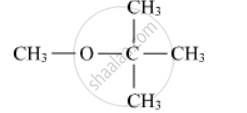
Write the structures of the products when Butan-2-ol reacts with CrO3
C6H5OCH2CH3 is called:
The compound HOCH2 – CH2OH is __________.
n-Propyl alcohol and isopropyl alcohol can be chemically distinguished by which reagent?
The major product formed by the reaction:
\[\begin{array}{cc}
\ce{CH3CH-CH2Br ->[CH3O^-][CH3OH] is}\\
|\phantom{................}\\
\ce{CH3}\phantom{.............}
\end{array}\]
\[\ce{HC ≡ CH ->[HgSO4][H2SO4] ->[CH3MgBr][H2O] ->[PBr3]}\]
The heating of phenyl methyl ether with HI produces:
Among the following sets of reactants which one produces anisole?
IUPAC name of the compound is:
\[\begin{array}{cc}
\ce{CH3-CH-OCH3}\\
|\phantom{....}\\
\ce{CH3}\phantom{..}
\end{array}\]
Which of the following compounds will react with sodium hydroxide solution in water?
Explain why p-nitrophenol is more acidic than phenol.
Write the IUPAC name.
\[\begin{array}{cc}
\phantom{................}\ce{CH3}\\
\phantom{.............}|\\
\ce{CH3 - CH - CH - C -CH3}\\
\phantom{.}|\phantom{......}|\phantom{......}|\\
\phantom{....}\ce{CH3\phantom{...}\ce{OH}\phantom{...}\ce{CH3}}\
\end{array}\]
