Advertisements
Advertisements
प्रश्न
IUPAC name of the compound \[\begin{array}{cc}
\ce{CH3 - CH - OCH3}\\
\phantom{}|\phantom{....}\\
\phantom{}\ce{CH3}\phantom{..}
\end{array}\] is ______.
पर्याय
1-methoxy-1-methylethane
2-methoxy-2-methylethane
2-methoxypropane
isopropylmethyl ether
Advertisements
उत्तर
IUPAC name of the compound \[\begin{array}{cc}
\ce{CH3 - CH - OCH3}\\
\phantom{}|\phantom{....}\\
\phantom{}\ce{CH3}\phantom{..}
\end{array}\] is 2-methoxypropane.
Explanation:
Given molecule: \[\begin{array}{cc}
\ce{CH3 - CH - OCH3}\\
\phantom{}|\phantom{....}\\
\phantom{}\ce{CH3}\phantom{..}
\end{array}\]
It is an ether ROR′. In naming ether, a smaller alkyl group among R and R' is treated as a side group as alkoxy and the other as alkane along with the position of the alkoxy group. Thus in the given molecule, it is the methoxy group at the second position of propane (alkane).
\[\begin{array}{cc}
\ce{\overset{1}{C}H3-\overset{2}{C}H-OCH3}\\
\phantom{}|\phantom{....}\\
\phantom{}\ce{\overset{3}{C}H3}\phantom{..}
\end{array}\]
APPEARS IN
संबंधित प्रश्न
What is metamerism?
Write IUPAC name of the following compound:

- Draw the structures of all isomeric alcohols of molecular formula C5H12O and give their IUPAC names.
- Classify the isomers of alcohols in the above question as primary, secondary and tertiary alcohols.
Give the IUPAC name of the following ether:
\[\begin{array}{cc}
\ce{C2H5OCH2 - CH - CH3}\\
\phantom{.........}|\\
\phantom{.............}\ce{CH3}
\end{array}\]
Give the IUPAC name of the following ether:
CH3CH2CH2OCH3
Write the structures of the products when Butan-2-ol reacts with SOCl2
Write the IUPAC name of the following :

Write structural formulae for Cyclohex-2-en-1-ol.
Give IUPAC names of the following compound:

An example of a compound with functional group – O – is ____________.
Ethylene reacts with Baeyer’s reagent to give ______.
When ethyl alcohol reacts with acetic acid, the products formed are:
The IUPAC name of the ether CH2 = CH–CH2OCH3 is:
Which of the following gives a positive iodoform test?
Arrange the following compounds in decreasing order of acidity.
\[\ce{H2O, ROH, HC ≡ CH}\]
Match the starting materials given in Column I with the products formed by these (Column II) in the reaction with HI.
| Column I | Column II | ||
| (i) | CH3—O—CH3 | (a) |  |
| (ii) | \[\begin{array}{cc} \ce{CH3}\phantom{..................}\\ \backslash\phantom{.............}\\ \ce{CH-O-CH3}\\ /\phantom{..............}\\ \ce{CH3}\phantom{..................} \end{array}\] |
(b) | \[\begin{array}{cc} \ce{CH3}\phantom{....}\\ |\phantom{.......}\\ \ce{CH3-C-I + CH3OH}\\ |\phantom{.......}\\ \ce{CH3}\phantom{....} \end{array}\] |
| (iii) | \[\begin{array}{cc} \ce{CH3}\phantom{.}\\ |\phantom{....}\\ \ce{H3C-C-O-CH3}\\ |\phantom{....}\\ \ce{CH3}\phantom{..} \end{array}\] |
(c) | 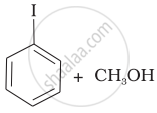 |
| (iv) |  |
(d) | CH3—OH + CH3—I |
| (e) | \[\begin{array}{cc} \ce{CH3}\phantom{.....................}\\ \backslash\phantom{.................}\\ \ce{CH-OH + CH3I}\\ /\phantom{.................}\\ \ce{CH3}\phantom{.....................} \end{array}\] |
||
| (f) | \[\begin{array}{cc} \ce{CH3}\phantom{.....................}\\ \backslash\phantom{.................}\\ \ce{CH-I + CH3OH}\\ /\phantom{.................}\\ \ce{CH3}\phantom{.....................} \end{array}\] |
||
| (g) | \[\begin{array}{cc} \ce{CH3}\phantom{....}\\ |\phantom{.......}\\ \ce{CH3-C-OH + CH3I}\\ |\phantom{.......}\\ \ce{CH3}\phantom{....} \end{array}\] |
Assertion: IUPAC name of the compound
\[\begin{array}{cc}
\ce{CH3 - CH - O - CH2 - CH2 - CH3}\\
|\phantom{....................}\\
\ce{CH3}\phantom{.................}
\end{array}\] is 2-Ethoxy-2-methylethane.
Reason: In IUPAC nomenclature, ether is regarded as hydrocarbon derivative in which a hydrogen atom is replaced by —OR or —OAr group [where R = alkyl group and Ar = aryl group]
Convert the following:
Ethyl alcohol into ethyl acetate.
Write a chemical reaction for the following conversion:
Acetic acid into ethyl alcohol.
