Advertisements
Advertisements
प्रश्न
What modification is done on the Ti plasmid of Agrobacterium tumefaciens to convert it into a cloning vector?
Advertisements
उत्तर
T-DNA is the only essential part required to make Ti plasmid a cloning vector. The plasmid is disarmed by deleting the tumour-inducing genes in the plasmid so that it becomes an effective cloning vector and remove it harmful effect.
APPEARS IN
संबंधित प्रश्न
State how has Agrobacterium tumifaciens been made a useful cloning vector to transfer DNA to plant cells.
Can you think and answer how a reporter enzyme can be used to monitor the transformation of host cells by foreign DNA in addition to a selectable marker?
How does the β-galactosidase coding sequence act as a selectable marker? Why is it a preferred selectable marker to antibiotic resistance genes? Explain.
The genetic material of virus includes:
A clone is a ______.
Which of the following is correctly matched?
Which of the following is not a genetic vector?
A cloning vector should possess which of the following characters?
- Origin of replication (Ori)
- Ability to destroy the alien DNA
- Cloning site to link the alien DNA
- The tumour inducing plasmid Ti.
- Selectable marker.
- Low molecular weight
The CORRECT combination is
For selection of recombinants, insertional inactivation of antibiotic marker has been superceded by insertional inactivation of a marker gene coding for a chromogenic substrate. Give reasons.
Which of the following enzyme(s) are NOT essential for gene cloning?
- Restriction enzymes
- DNA ligase
- DNA mutase
- DNA recombinase
- DNA polymerase
Choose the correct answer from the options given below:
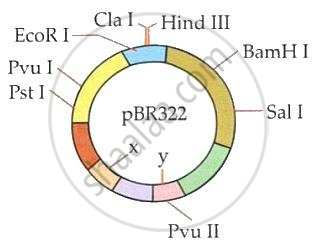
The following diagram showing restriction sites in E. coli cloning vector pBR322. Find the role of ‘X’ and ‘Y’ genes:
The “Ti plasmid” of Agrobacterium tumefaciens stands for ______.
What is the primary function of a vector in recombinant DNA technology?
Which of the following describes the function of a selectable marker in a cloning vector?
What is the primary role of a cloning site in a vector?
Which vector derived from \(\textit{Agrobacterium tumefaciens}\) is utilized for delivering foreign genes into plants?
Which of the following is a group of vectors used for gene transfer into animals?
