Advertisements
Advertisements
प्रश्न
Sucrose decomposes in acid solution into glucose and fructose according to the first order rate law with t1/2 = 3 hours. What fraction of the sample of sucrose remains after 8 hours?
Advertisements
उत्तर
Given: t1/2 = 3 Hours
Now we know that,
k = `0.693/t_(1//2)`
= `0.693/3`
= 0.231 hr−1
Put the above value in the formula of a first-order reaction.
k = `2.303/8 log [R]_0/([R])`
⇒ 0.231 = `2.303/8 log [R]_0/([R])`
⇒ `log [R]_0/([R]) = (0.231 xx 8)/2.303`
= `1.848/2.303`
⇒ `log [R]_0/([R])` = 0.8024
⇒ `[R]_0/([R])` = antilog 0.8024
= 6.3445
`[R]/([R]_0) = 1/6.3445`
= 0.158
∴ The fraction of the sample of sucrose remaining after 8 hours is 0.158.
संबंधित प्रश्न
A first order reaction has a rate constant 1.15 × 10⁻³ s−1. How long will 5 g of this reactant take to reduce to 3 g?
Time required to decompose SO2Cl2 to half of its initial amount is 60 minutes. If the decomposition is a first order reaction, calculate the rate constant of the reaction.
The following data were obtained during the first order thermal decomposition of SO2Cl2 at a constant volume.
\[\ce{SO2Cl2_{(g)} -> SO2_{(g)} + Cl2_{(g)}}\]
| Experiment | Time/s–1 | Total pressure/atm |
| 1 | 0 | 0.5 |
| 2 | 100 | 0.6 |
Calculate the rate of the reaction when total pressure is 0.65 atm.
In a pseudo first order reaction in water, the following results were obtained:
| t/s | 0 | 30 | 60 | 90 |
| [A]/mol L−1 | 0.55 | 0.31 | 0.17 | 0.085 |
Calculate the average rate of reaction between the time interval 30 to 60 seconds.
For the decomposition of azoisopropane to hexane and nitrogen at 543 K, the following data are obtained.
| t (sec) | P(mm of Hg) |
| 0 | 35.0 |
| 360 | 54.0 |
| 720 | 63.0 |
Calculate the rate constant.
The time required for 10% completion of a first order reaction at 298 K is equal to that required for its 25% completion at 308 K. If the value of A is 4 × 10¹⁰ s−1. Calculate k at 318 K and Ea.
A first order reaction takes 20 minutes for 25% decomposition. Calculate the time when 75% of the reaction will be completed.
(Given : log = 2 = 0·3010, log 3 = 0·4771, log 4 = 0·6021)
A first order reaction is 50% complete in 25 minutes. Calculate the time for 80% completion of the reaction.
Show that the time required for 99.9% completion of a first-order reaction is three times the time required for 90% completion.
Straight line graph for first order reaction is obtained between ____________.
A first order reaction is 50% completed in 1.26 × 10¹⁴ s. How much time would it take for 100% completion?
Which of the following graphs is correct for a first order reaction?


With the help of an example explain what is meant by pseudo first order reaction.
In the presence of acid, the initial concentration of cane sugar was reduced from 0.2 M to 0.1 Min 5 hours and to 0.05 Min 10 hours. The reaction must be of?
The rate constant of a first order reaction is 6.9 × 10⁻³s–1. How much time will it take to reduce the initial concentration to its 1/8th value?
First order reaction is 50% complete in 1.26 × 10¹⁴s. How much time could it take for 100% completion?
A first order reaction is 50% complete in 20 minute What is rate constant?
The reaction X → product
Follow first order of kinetics. In 40 minutes the concentration of 'X' changes from 0.1 m to 0.025. M. The rate of reaction when concentration of X is 0.01 m is.
Time required to decompose SO2Cl2 to half of its initial concentration is 60 minutes. If the de-composite is a first order reaction, calculated the rate constant of the reaction-
In a first order reaction the concentration of reactants decreases from 400mol L-1 to 25 mol L-1 in 200 seconds. The rate constant for the reaction is ______.
Observe the graph shown in figure and answer the following questions:
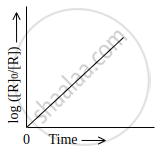
- What is the order of the reaction?
- What is the slope of the curve?
- Write the relationship between k and t1/2 (half life period).
Gaseous cyclobutene isomerizes to butadiene in a first order process which has a 'k' value of 3.3 × 10⁻⁴ s−1 at 153°C. The time in minutes it takes for the isomerization to proceed 40% to completion at this temperature is ______. (Rounded-off to the nearest integer)
A definite volume of H2O2 undergoing spontaneous decomposition required 22.8 c.c. of standard permanganate solution for titration. After 10 and 20 minutes respectively the volumes of permanganate required were 13.8 and 8.25 c.c. The time required for the decomposition to be half completed is ______ min.
The reaction \[\ce{SO2Cl2(g) -> SO2(g) + Cl2(g)}\] is a first-order gas reaction with k = 2.2 × 10⁻⁵ sec−1 at 320°C. The percentage of SO2Cl2 is decomposed on heating this gas for 90 min, is ______%.
For a first order reaction, the ratio of the time for 75% completion of a reaction to the time for 50% completion is ______. (Integer answer)
The slope in the plot of ln[R] vs. time for a first order reaction is ______.
The slope in the plot of `log ["R"]_0/(["R"])` Vs. time for a first-order reaction is ______.
Radioactive decay follows first-order kinetics. The initial amount of two radioactive elements X and Y is 1 gm each. What will be the ratio of X and Y after two days if their half-lives are 12 hours and 16 hours respectively?
What is the rate constant?
Define first-order reaction.
The following data were obtained during the decomposition of SO2Cl2 at the constant volume. SO2Cl2 →SO2(g) + Cl2(g)
| Time (s) | Total Pressure (bar) |
| 0 | 0.5 |
| 100 | 0.6 |
Calculate the rate constant of the reaction.
Slove: \[\ce{2NOBr -> 2NO_{2(g)} + Br_{2(g)}}\]
For the above reaction, the rate law is rate = k[NOBr]2. If the rate of reaction is 6.5 × 10⁻⁶ mol L−1 s−1 at 2 × 10⁻³ mol L−1 concentration of NOBr, calculate the rate constant k for the reaction.
Show that `t_(1/2)= 0.693/k` for first reaction.
Write the unit of rate constant [k] for the first order reaction.
